Table of Contents
When people talk about the stock market, they sometimes use tricky words and ask questions like What is liquidity? Liquidity simply describes how easy it is to turn something you own into cash without losing a lot of value. Imagine you are at school with a bag of apples. You want to swap your apples for some candy. If lots of friends want apples and have candy to offer, you can trade quickly at a fair price. But if hardly anyone is interested in apples, you may have to wait a long time or accept less candy for each apple. This idea of easy swapping is the heart of liquidity investopedia.com.
In finance, liquidity helps markets run smoothly. It matters in India on busy exchanges like the National Stock Exchange (NSE) and the Bombay Stock Exchange (BSE), and it matters in the United States on the New York Stock Exchange (NYSE) and the NASDAQ. Let’s explore what liquidity means, why it’s important, how to spot it and learn from examples in both countries.
A Simple Definition of Liquidity
Liquidity refers to the ease with which an asset – such as a stock, bond or even a collectible toy – can be turned into cash without causing its price to drop. In other words, if something is highly liquid, you can sell it quickly and get a fair price. Cash itself is perfectly liquid, because you can spend it on anything immediately. Stocks of large, well‑known companies are also usually very liquid because many buyers and sellers trade them every day. Illiquid assets take more time to sell and may require price discounts. Real estate, rare books or a unique cricket bat signed by your favorite player might be valuable, but finding a buyer at the right price takes effort.
Liquidity in Everyday Life

One way to picture liquidity is to compare different liquids. Water flows easily from a glass; honey drips slowly. In the same way, some assets “flow” in the market more freely than others. The illustration above shows water labelled “Liquid Assets” on the left and honey labelled “Illiquid Assets” on the right. The water flows out quickly, while the honey drips slowly, representing the difference between assets you can trade easily and those that take time.
Market Liquidity vs. Accounting Liquidity
There are two important types of liquidity:
- Market liquidity. This describes how easy it is to buy or sell an asset in a market at a stable price. High market liquidity means there are plenty of buyers and sellers, so the price doesn’t change much even when a big trade happens. Stocks, bonds and currencies traded on major exchanges usually have good market liquidity. Real estate, art or rare collectibles have poor market liquidity because finding a buyer is harder.
- Accounting liquidity. This measures how well a company can pay its short‑term bills using its liquid assets. It’s like checking if you have enough pocket money to buy lunch today and pay for tomorrow’s bus ticket. Analysts use ratios such as the current ratio, quick (acid‑test) ratio and cash ratio to see if a company’s cash and near‑cash assets can cover its short‑term debt. A higher ratio suggests the company is better able to meet its obligations without financial stress.
Why Liquidity Matters

Liquidity might seem like a grown‑up concept, but it affects everyone who invests or owns assets. Here are some reasons why it is so important:
1. It Makes Transactions Easier
In a liquid market, there are always enough buyers and sellers. That means you can enter or exit investments quickly without waiting around.
2. It Ensures Fair Pricing
Liquidity improves the price discovery process. When lots of people trade a stock, news and information get reflected in its price quickly. Because there is strong competition between buyers and sellers, the difference between the highest price someone is willing to pay (the bid) and the lowest price someone is willing to accept (the ask) becomes very small. This difference is called the bid‑ask spread. A narrower spread means it costs less to trade and the price you get is fairer investopedia.com.

The illustration above compares a narrow bid‑ask spread with a wide one. The kids standing close together have a “narrow spread,” while the kids standing far apart show a “wide spread,” which usually occurs in illiquid markets. Although the illustration doesn’t fully do justice to the explanation, but nevertheless it is shown to explain this complex subject into a kid friendly manner.
3. It Adds Stability
When markets have high liquidity, they can absorb large trades without big price swings lakshmishree.com. This price resilience keeps the market stable. Think of waves in a calm pond when a stone is tossed; the water quickly returns to normal. In an illiquid market, the pond is tiny and a stone makes big waves – prices jump around more.
4. It Builds Investor Confidence
Investors like markets where they know they can buy and sell quickly at reasonable prices lakshmishree.com. When there is high liquidity, they feel more confident investing, which helps businesses raise money to grow. That’s why India’s large exchanges and America’s major stock markets attract investors from around the world.
5. It Helps With Big Trades
Large investors, such as mutual funds and pension funds, often need to trade millions of shares. Liquidity allows them to place these big orders without dramatically moving the price. If they tried to sell a huge amount of shares in an illiquid stock, the price would drop sharply, hurting both the seller and other investors.
Measuring Liquidity

How do we know if a stock is liquid? Traders and researchers look at several factors:
- Trading volume. This is the number of shares traded each day. High volume means lots of buyers and sellers. For example, on March 13 2023, about 69.6 million shares of Amazon (AMZN) were traded, while 48.1 million shares of Intel (INTC) changed hands and 118.5 million shares of Ford (F) traded. Ford’s higher volume that day made it the most liquid of the three.
- Bid‑ask spread. A narrow spread indicates that buyers and sellers agree on price, which is typical in liquid stocks.
- Market depth. This is the number of buy and sell orders waiting at different price levels. Deep markets can absorb large orders without big price changes.
- Price resilience. In a liquid market, prices bounce back quickly after a big trade.
- Ratios for companies. For accounting liquidity, analysts use the current ratio, quick ratio and cash ratio to see if companies can meet short‑term obligations. A higher ratio suggests healthier finances.
These measurements help investors decide which stocks suit their trading style and risk tolerance.
Examples From India and the United States
India: Reliance Industries and a Bustling Stock Exchange
India’s stock exchanges are among the most active in the world. A great example of liquidity is Reliance Industries Limited (RIL). RIL is one of India’s largest companies, so its shares trade in large volumes every day on the NSE and BSE. Because so many people buy and sell RIL shares, the bid‑ask spread is narrow and prices remain stable even when someone sells hundreds of shares. Investors can enter or exit positions quickly, which reduces risk and encourages more participation.

The cartoon above illustrates a busy Indian stock market. The building, inspired by the BSE, has the Indian flag waving on top. Many people are exchanging stock slips and money, showing how lively trading can be when liquidity is high.
Liquidity also matters during initial public offerings (IPOs). When food‑delivery company Zomato went public in 2021, investors flocked to buy and sell its shares. The high trading volume made it easy to trade and kept prices relatively stable. This shows how good liquidity supports fair pricing even when a company first lists its shares lakshmishree.com.
Indian stock markets aren’t always liquid. Shares of small, lesser‑known companies may have low trading volumes. If you own shares of a tiny company that few people know about, finding a buyer can be harder. It’s like owning a rare cricket card – valuable but hard to trade. Because of this, investors must consider liquidity risk before buying such shares.
United States: Amazon, Apple and the NYSE
In the United States, big technology firms often set the pace for liquidity. Amazon (AMZN), Intel (INTC) and Ford (F) traded millions of shares on March 13 2023, with Ford leading at 118.5 million shares. High trading volumes like this make it easy for investors to enter and exit positions quickly without large price changes.

Another famous example is Apple (AAPL). Apple is one of the most valuable companies in the world, and its shares are traded by large institutional investors and everyday people. Because Apple stocks are so widely followed, the bid‑ask spread stays narrow and the market can absorb large orders. The cartoon above shows the front of the NYSE with an American flag and a big Apple logo to remind us that certain stocks, like Apple, have incredibly high liquidity.
Just like in India, not every U.S. stock has high liquidity. Smaller companies listed on regional exchanges or the over‑the‑counter market may have lower trading volumes and wider bid‑ask spreads. Investors need to be careful when trading such stocks because buying or selling a large number of shares could move the price significantly. In other words, less traffic on the road means each car makes a bigger splash.
Everyday Examples for Kids
To see liquidity in action, let’s use child‑friendly scenarios:
- Apple and candy trade. If you swap apples for candy in the schoolyard, this is like trading in a liquid market. Lots of friends want to trade, so you find partners quickly. The first illustration shows two kids exchanging apples and candies happily – a metaphor for easy trading.

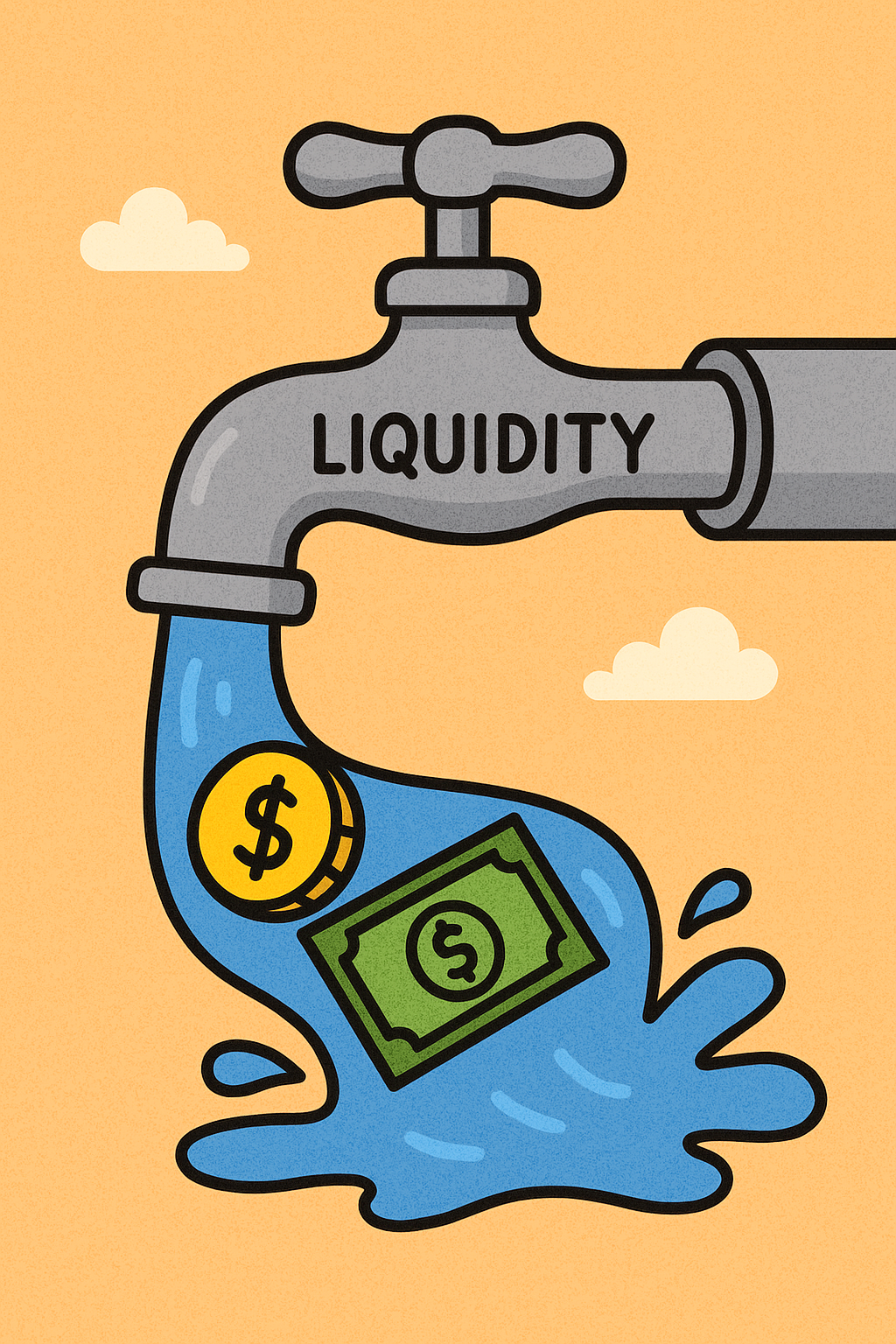
- The water tap. Think of liquidity like a water tap. When you turn the handle, water (money) flows freely. The illustration of a tap labeled “Liquidity” reminds us that liquid assets flow easily like water. Assets that are hard to sell are more like honey – they move slowly.
- Trading across borders. In the cartoon below, a boy wearing an Indian kurta and holding a rupee symbol is trading stocks with a girl wearing an American T‑shirt holding a dollar symbol. This shows that liquidity exists in markets everywhere, whether you trade in rupees or dollars.

- Busy vs. quiet stands. A lemonade stand with lots of customers is like a liquid market – goods change hands easily. A lonely stand with no customers is like an illiquid market. Our cartoon of an “Illiquid Market” lemonade stand shows how boring it is when no one comes to buy, and why investors avoid such situations.

Liquidity in the Economy
Liquidity doesn’t just matter to traders; it helps the whole economy. When markets are liquid:
- Companies can raise money more easily by issuing shares or bonds. Investors know they can trade those securities when needed.
- Banks and financial institutions can lend and borrow with confidence, keeping the banking system stable.
- Governments can sell treasury bills and bonds to fund schools, hospitals and infrastructure.
- Everyday people can invest, save and plan for the future, knowing that their savings are accessible without big penalties.
Conversely, liquidity crises can cause problems. If companies can’t sell assets quickly, they may not meet obligations like paying workers or suppliers investopedia.com. For families, illiquid assets may prevent them from paying bills on time. That’s why regulators watch market liquidity and central banks provide emergency liquidity when markets freeze.
How to Spot a Liquid Stock

When you, your parents or teachers look at investing, consider these simple checks:
- Check the trading volume. High daily volume (millions of shares) usually means high liquidity. Stocks of large companies like Reliance or Apple trade millions of shares each day, making them easy to buy or sell.
- Look at the bid‑ask spread. A tight spread (for example, buying at ₹100 and selling at ₹100.10) shows that buyers and sellers agree on price and you won’t lose much money when you trade.
- Observe market depth. On trading platforms, you can see the number of shares available at different price levels. More orders mean better depth.
- Consider company size and popularity. Big companies with well‑known products often have more liquid stocks because more people want to trade them.
- Review financial ratios. For investors analyzing companies, look at the current, quick and cash ratios to see if the business has enough liquid assets to pay its bills investopedia.com.
Remember, a liquid stock isn’t always a good investment – it just means you can trade it easily. You still need to research whether the company is profitable and fits your goals.
Liquidity and Risk

Liquidity isn’t just about convenience; it’s also about risk. Liquidity risk is the danger that you won’t be able to buy or sell an asset quickly without a large price change. It shows up when markets are stressed or when you hold assets that few people want. For example, during the 2016 demonetization in India, old ₹500 and ₹1,000 notes were no longer legal tender. People struggled to exchange them, which suddenly made cash less liquid. This event demonstrated how changes in policy can affect liquidity in everyday life.
In financial markets, liquidity risk can appear when there are sudden market shocks, such as economic crises or big political events. To manage this risk, investors diversify their portfolios, keep some cash or cash‑equivalent securities and avoid investing too much in illiquid assets. Financial regulators also monitor liquidity to ensure that banks and markets can handle unexpected stresses.
Final Thoughts
Liquidity helps the stock markets of both India and the United States function smoothly. It allows investors to buy and sell shares quickly at fair prices, supports stable markets and encourages businesses to grow. By understanding how liquidity works and how to measure it, even young readers can see why it matters in the world around them. The next time you swap apples for candy, pay attention to how easy the trade is – you’re experiencing liquidity in its simplest form!
If You Liked This Article, Then You Might Also Like This –