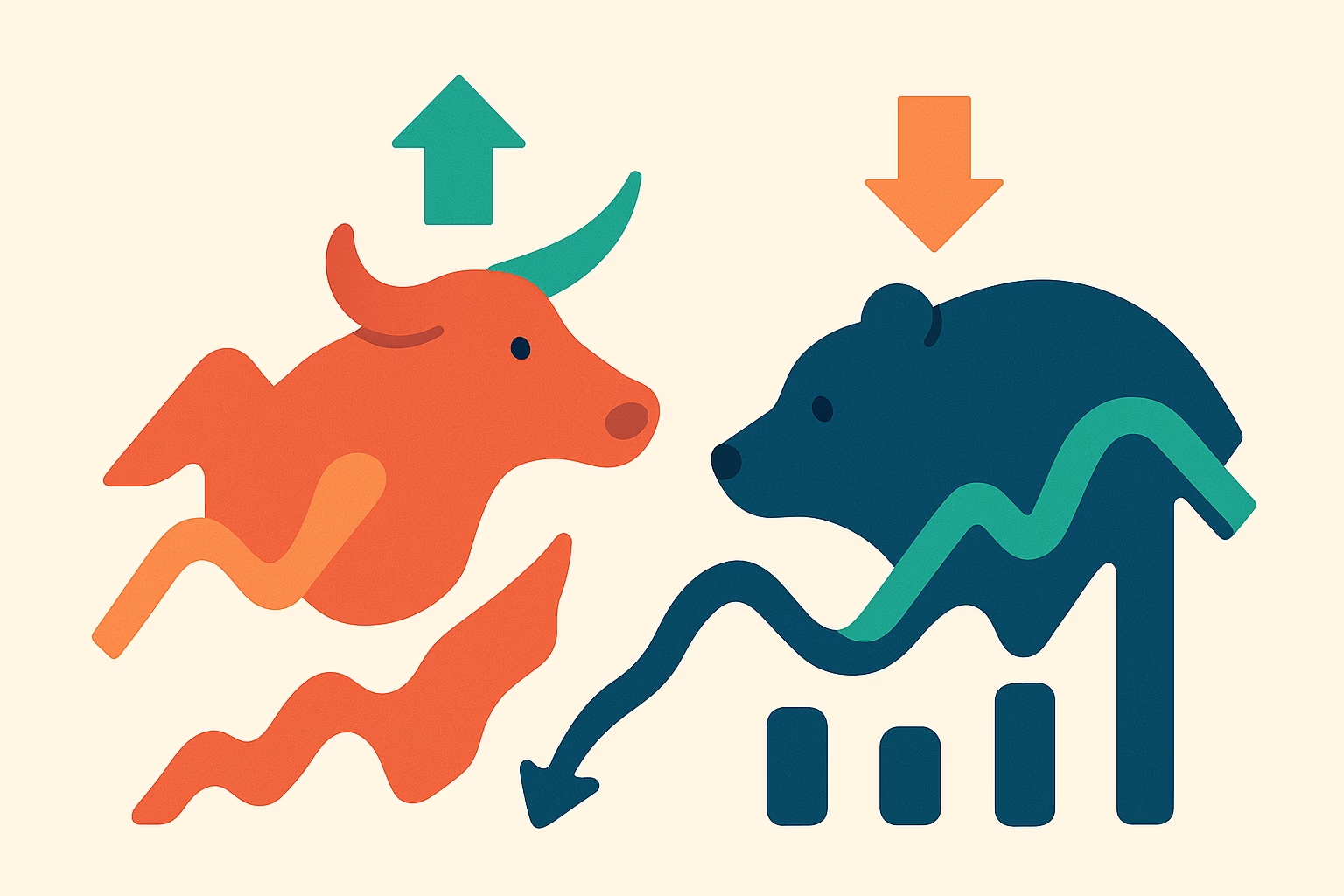
Investing means putting money into something with the hope that it will grow into more money in the future. People invest in all sorts of things – from piggy banks, to bank accounts, to stocks and bonds. Understanding the difference between long‑term and short‑term investing helps you decide where to put your money and for how long. This article breaks down both approaches in a simple way, using easy examples and images so that even a 10‑year‑old can grasp the key ideas. Keep in mind that while investing can help your money grow, all investments involve some risk – the value can go up or down. The goal is to find a balance between how much risk you can handle and how long you can let your money work for you.
What Is Long‑Term Investing?
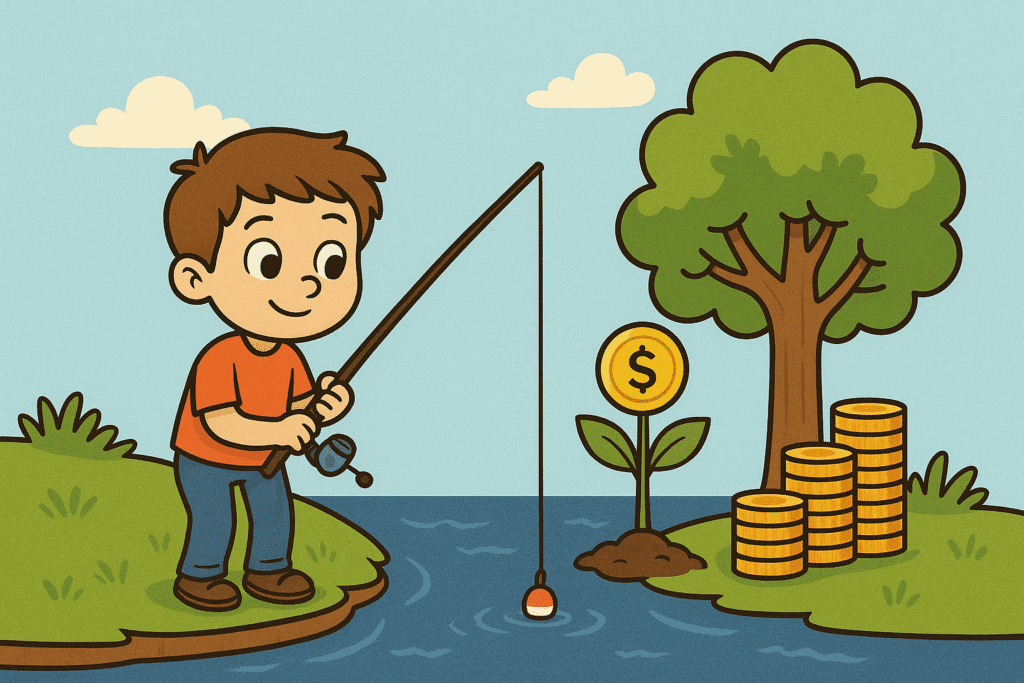
Long‑term investing means holding an investment for many years. In finance, anything you keep for more than 12 months is considered a long‑term holding investopedia.com, and serious long‑term investors often plan for 5–10 years or more. People who invest for the long term buy things like company stocks, mutual funds (a basket of stocks or bonds managed by professionals), bonds that pay interest, or exchange‑traded funds (ETFs) that track an index. They do not buy and sell every week; they let their money stay invested to give it time to grow.
Why does time matter?
Markets (like the stock market) go up and down. Prices might drop for months or even years, but over long periods they have historically risen. For example, the S&P 500 index – a group of 500 large U.S. companies – only had negative annual returns in 13 out of 50 years between 1974 and 2024 investopedia.com. When investors hold onto stocks for two decades or more, they rarely lose money. That’s because they have time to ride out highs and lows. If the stock market falls this year, a long‑term investor doesn’t panic; instead, they wait for the market to recover, which historically it has done over time.
Types of long‑term investments
- Stocks and equities. These represent tiny slices of companies. They are considered long‑term investments because the value can swing up or down a lot in the short run. Owning shares gives you a chance to profit when a company grows, and sometimes the company pays a share of its profits (called dividends).
- Bonds. A bond is like a loan you give to a company or a government. They promise to pay back the money plus interest on a set date, which can be 10, 20 or even 30 years from now corporatefinanceinstitute.com. Bonds usually have less price movement than stocks, but they can still go up or down depending on interest rates and the financial health of the borrower investor.gov.
- Mutual funds and ETFs. These are collections of stocks, bonds or both. Because they hold many different investments, they are more diversified and can spread out risk. Investors use them to invest in the market without picking individual companies.
The power of compounding
One of the biggest advantages of long‑term investing is compound growth. Compounding means you earn interest or returns on the money you invest and on any previous earnings. When left alone over many years, this snowball effect can turn small savings into a large sum. To illustrate, imagine planting a seed that slowly grows into a tall tree. The longer the tree grows, the bigger it becomes. This idea is captured in the image below:
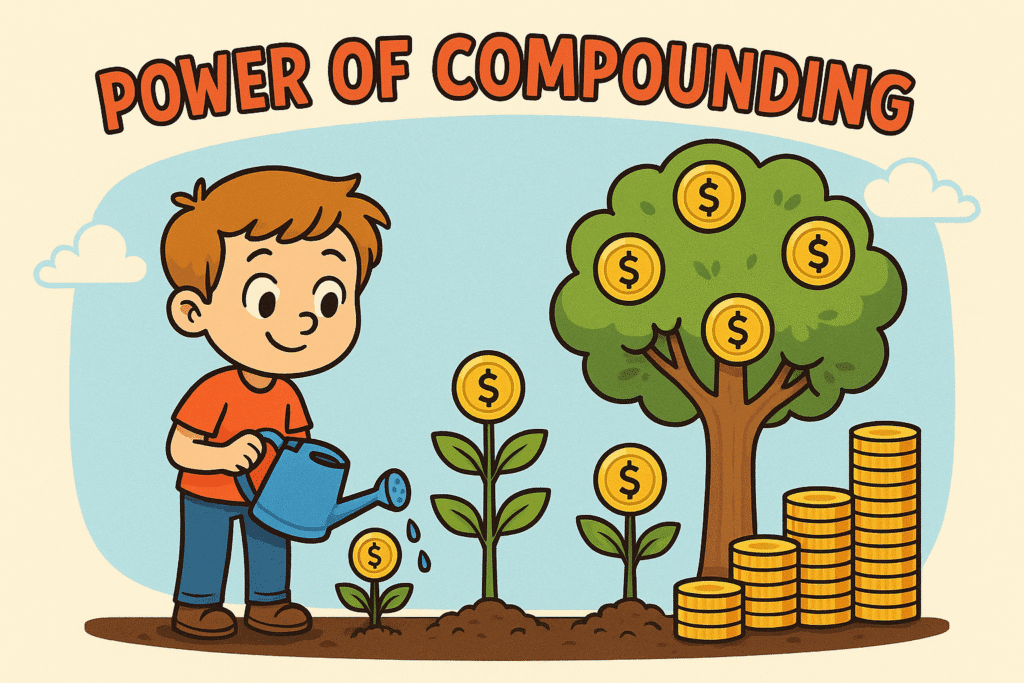
In financial terms, long‑term investments like stocks have produced higher average returns than most other asset classes over the decades. The S&P 500 index delivered an average annual return of about 9.8 % from 1928 to 2023, while short‑term Treasury bills earned only about 3.3 % and 10‑year Treasury notes around 4.86 % investopedia.com. Put simply, long‑term investments have historically rewarded patience.
Emotional and cost advantages
Long‑term investing also helps reduce emotional decision‑making. Many people are tempted to sell when markets fall and buy when markets rise. This “buy high, sell low” behavior hurts returns. By committing to a long‑term strategy, investors are less likely to panic during downturns. There are also tax advantages. In many countries, such as the United States, profits from assets held for more than a year are taxed at a lower long‑term capital gains rate (usually capped at 20 %). In contrast, selling within a year triggers short‑term capital gains taxes, which can be as high as ordinary income tax rates. Fewer trades also mean fewer transaction fees.
Risks of long‑term investing
Long‑term investing isn’t magic. Volatility (big price swings) can be stressful corporatefinanceinstitute.com. Stocks can fall 10–20 % or more, and it may take years to recover. Investors must accept that there will be periods when the value of their investments is lower than the price they paid. There is also company risk – if a company performs poorly, its stock can lose value investor.gov – and inflation risk – the risk that the money you earn doesn’t keep up with rising prices. But by diversifying across different types of investments and sticking with them for years, you can reduce these risks.
What Is Short‑Term Investing?
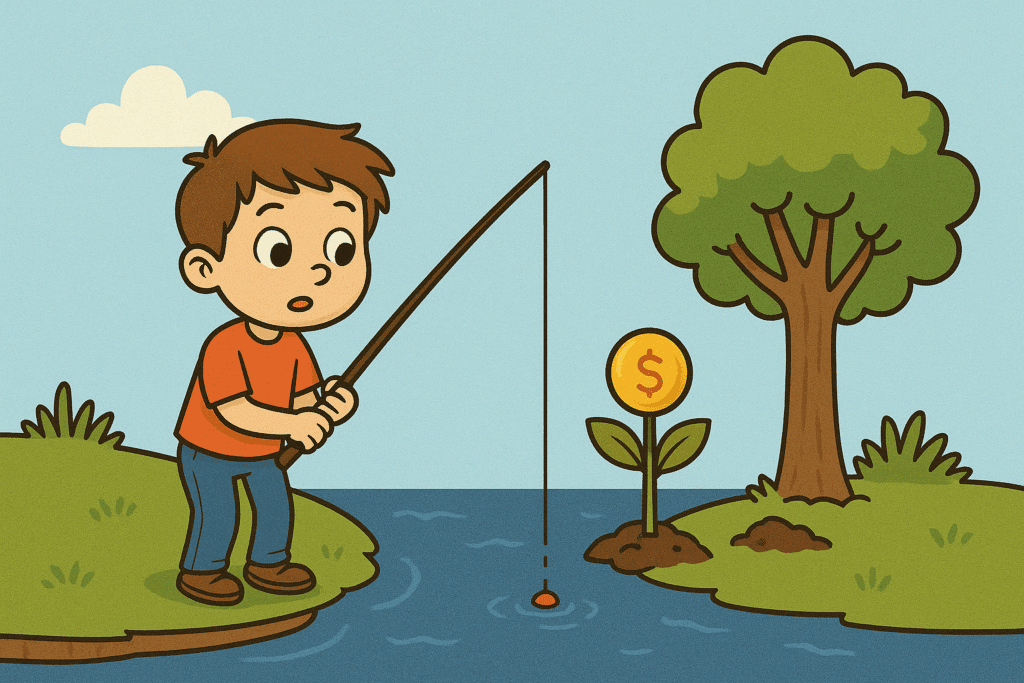
Short‑term investing involves buying assets with the intention of holding them for less than one year. The goal is often to preserve capital or earn a small return while waiting to use the money for something soon, such as buying a car or going on vacation corporatefinanceinstitute.com. Instead of investing in volatile stocks, short‑term investors prefer instruments that offer principal protection and liquidity (meaning it’s easy to get your cash back quickly).
Types of short‑term investments
- Savings accounts and money market accounts. These are bank accounts that pay interest. They are federally insured, which means your money is protected even if the bank fails. You can withdraw your money at any time, but the trade‑off for safety and convenience is a low interest rate investor.gov.
- Certificates of deposit (CDs). A CD is a deposit you make with a bank for a fixed period – anywhere from a few months to a few years. CDs pay a fixed interest rate that is usually a bit higher than regular savings accounts. Because the rate is locked in, you know exactly how much you will earn, but your money is locked up until the CD matures. Taking your money out early often results in a penalty.
- Treasury bills and government bonds. Treasury bills (T‑bills) mature in less than a year and are backed by the government, making them extremely safe. Treasury notes and bonds have longer maturities but still carry low risk because the government promises to repay them. Their safety means the returns are modest.
- Money market funds and short‑term bond funds. These investment funds hold a portfolio of short‑term debt instruments like T‑bills, commercial paper and certificates of deposit. They aim to maintain a stable price and provide slightly better returns than bank accounts. However, they are not federally insured, so there is a small risk of loss.
In the CFI article, short‑term investment vehicles are described as ultra‑short‑term bonds, convertible notes, money‑market investments, bridge loans and capital notes. These instruments are chosen because they carry relatively low risk and are expected to be returned quickly.
Benefits of short‑term investing

Short‑term investing can be useful when you need access to your money soon or when you cannot tolerate big swings in value. Key benefits include:
- Liquidity. Because these investments are meant to be held for only a few months, you can get your money quickly when you need it. Savings accounts allow withdrawals at any time, while money market funds can be sold at the current price. Even CDs often have shorter terms than long‑term investments.
- Principal protection. Many short‑term products, such as savings accounts and CDs, protect your principal. The CFI article notes that short‑term investments are purchased “to provide a higher degree of principal protection”. That means the amount you invest is unlikely to shrink dramatically.
- Useful for near‑term goals. Short‑term investments are handy for goals you hope to reach soon – like making a down payment on a house, paying for a vacation or building an emergency fund.
Risks of short‑term investing
Even though short‑term investments are considered safe, they aren’t risk‑free. The main risk is that returns are low and may not keep up with rising prices (inflation). For example, the interest rate on savings products is often lower than the rate of inflation. Over time, inflation erodes the “purchasing power” of your money. Imagine saving ₹100 and earning 1 % per year in interest while prices rise 4 % per year. After a few years, you might have ₹103 but find that the things you want now cost much more.
Additionally, because returns are small, there is a chance that you might be tempted to take bigger risks to earn more, which could defeat the purpose of safety. Short‑term investing also doesn’t benefit from compounding as much as long‑term investing because the money is not invested long enough.
Risk and Return: The Trade‑Off

Investors always balance risk (the chance of losing money) and return (how much money they expect to earn). This relationship is known as the risk‑return trade‑off. The principle states that higher returns usually require accepting higher risk. Conversely, investments that promise safety often offer lower returns. The key is to find the level of risk that matches your goals and how much uncertainty you can handle.
How time changes risk
According to Investopedia, time plays an important role in risk. Investors who can keep money invested over the long term have a greater chance to recover from short‑term losses. For example, if a stock drops in value this year, a long‑term investor can wait several years for the stock market to rise again. However, if you need the money back in three months, you don’t have time to wait for a recovery. That’s why stocks are considered more risky for short‑term goals.
The risk‑return trade‑off also depends on factors like risk tolerance, age and the ability to replace lost funds. Young investors often have decades to invest and can accept more risk because they have time to recover from market downturns. Older investors nearing retirement might prefer safer investments because they need their money soon.
Diversifying – spreading money across different types of investments – helps manage risk. A portfolio made entirely of stocks is riskier than a mix of stocks, bonds and short‑term instruments. Diversification can smooth the bumps because when one investment is down, another might be up.
Risk in long‑term and short‑term contexts
- Long‑term investors face volatility – the value of their investments can swing widely from year to year. Market downturns, economic shocks, or company‑specific problems can cause temporary losses. However, because they hold investments for many years, long‑term investors have time to let their investments recover and participate in future growth.
- Short‑term investors face inflation and opportunity risk. When you keep money in safe, low‑yield investments, there is a risk that inflation will reduce its value. There is also the opportunity risk that you miss out on larger gains from long‑term investments. On the other hand, taking big risks in the short term (such as trading volatile stocks) can lead to quick losses because there is little time to recover.
Comparing Long‑Term and Short‑Term Investing
The best way to understand the differences between these two approaches is by comparing their key characteristics. The table below summarizes the main points. To keep it simple, the table uses short phrases instead of long sentences. More details follow in the text below the table.
| Feature | Long‑Term Investing | Short‑Term Investing |
|---|---|---|
| Time horizon | Over 12 months; often 5–10+ years | Less than 1 year |
| Typical goal | Grow wealth, save for retirement or big future purchases | Preserve capital, prepare for near‑term needs like a house deposit |
| Common instruments | Stocks, mutual funds, ETFs, long‑term bonds | Savings accounts, money market funds, CDs, T‑bills |
| Expected return | Higher average return (e.g., stocks ~9.8 % historically) | Lower, often just above inflation |
| Primary risk | Market volatility and company performance | Inflation and opportunity cost |
| Liquidity (ease of access) | Low to moderate; may need to sell at market price | High; many instruments allow quick access or mature quickly |
| Taxes | Long‑term capital gains tax rates (max ~20 %) | Short‑term capital gains taxed as ordinary income |
| Who uses it | Investors with time and patience; those saving for future goals | People needing cash soon; risk‑averse investors |
Which approach is right for you?

There is no single answer because everyone’s situation is different. Long‑term investing is ideal for building wealth over decades, like saving for retirement or funding a child’s education. By leaving the money invested, you give it time to benefit from compounding and ride out market ups and downs. Short‑term investing is useful when you need money within a year or two. Putting emergency savings into a bank account or a short‑term bond ensures it will be there when you need it, even if the interest you earn is small.
In many cases, a combination of both strategies works best. The CFI article notes that young people starting out may want a mix of short‑term and long‑term investments: short‑term vehicles help with near‑term expenses like a down payment, while long‑term investments build a retirement nest egg. As you approach retirement, you might shift more money into short‑term investments so that market swings don’t jeopardize money you plan to spend soon.
Making Investing Easy to Understand
To help a young reader grasp these ideas, imagine two characters: Speedy Sam and Patient Priya.
Speedy Sam likes to see things happen quickly. He plants seeds and expects fruit tomorrow. He puts his allowance into a short‑term investment like a savings account. The next month he uses the money to buy a video game. His money was safe, and he didn’t have to worry about it changing value. However, he didn’t earn much extra.
Patient Priya plants a tiny tree and waters it every day. She knows it will take years before she can climb it. She invests in stocks and mutual funds and plans to leave the money there for many years. Some years the tree grows a lot; other years storms (market downturns) bend it, but it keeps growing overall. By the time she is ready for university, her investment has grown much more than she started with because of compounding. The longer she waited, the bigger her tree became.
This story teaches an important lesson: time is a powerful friend when it comes to investing. The sooner you start saving and the longer you leave your money to grow, the more you can benefit from compounding. Even small amounts saved regularly can turn into a significant sum over time.
Tips for Young Investors

- Start early. Even if you can only save a little, starting early gives your money more time to grow. A rupee saved at age 10 can grow much more by age 60 than a rupee saved at age 30.
- Set goals. Decide whether your goal is short‑term (buying a new bicycle) or long‑term (saving for college). Choose investments that match your timeline.
- Understand risk. Ask yourself how much risk you can handle. Stocks offer higher potential returns but can go up and down a lot. Bank accounts are safer but grow slowly. A diversified mix can spread risk.
- Be patient. Investing is like growing a tree; it takes time. Don’t worry about short‑term ups and downs, and avoid panic selling when the market drops.
- Keep learning. Read books, use calculators and talk with grown‑ups about money. Investing knowledge helps you make better decisions.
Conclusion
Long‑term and short‑term investing are two sides of the same coin. Long‑term investing involves keeping your money invested for years, allowing it to grow through compounding and to recover from market ups and downs. It offers higher potential returns but comes with the risk of volatility.
Short‑term investing focuses on safety and quick access to cash; it is useful for near‑term goals or emergency funds but yields lower returns and may not outpace inflation. The right choice depends on your goals, timeline and comfort with risk. Often, the best strategy is a mix of both: keep an emergency fund in safe, short‑term instruments while investing for future goals in diversified, long‑term assets. By understanding these concepts early and staying patient, you can make your money work for you and achieve the financial goals that matter most.