Introduction – Trading Toys and Treats
Imagine you and your friends love swapping toys. One day you decide to create a special place where anyone can buy or sell toys. Some toys are popular and become more valuable; other toys lose their appeal. That place would be a toy market. In the real world the “toys” are shares and the market is called the stock market. It’s a marketplace where pieces of companies are traded, much like how children trade action figures or stickers.
People buy stocks for many reasons. Some hope the price will rise, others want a share of the company’s profits, and some simply enjoy owning a piece of a famous brand. But to understand why people do this, you need to know what a stock is and how the market works.
What Exactly Is a Stock?

Think of a company as a whole pizza and stocks as slices of that pizza. If you own one slice, you own a small part of the pizza. Likewise, owning a stock means you own a small part of a company. When a company does well and makes profits, it may share some of those profits with its owners in the form of dividends. You might also get to vote on major company decisions. If the company becomes more valuable, each slice becomes more valuable, and you can sell your slice for more than you paid.
Just like a pizza has many slices, companies have many shares. The entire pizza is worth the sum of its slices. Companies “cut” themselves into shares so that people can invest small amounts. When you buy a share, you become a shareholder or stockholder.
Why Do Companies Sell Stocks?

Let’s say you want to build the biggest lemonade stand in your neighborhood. You need money for lemons, sugar, cups and a cool sign. Instead of borrowing from a bank, you can sell slices of your lemonade stand to your friends. They give you money to build the stand, and in return they own part of your business. When the stand makes money, your friends earn part of the profits and can sell their share to someone else.
This is how companies raise money. They go public—an event called an initial public offering (IPO)—so anyone can buy slices of their business. The company uses the money to grow and, in return, investors get a chance to share in the profits and price increases.
Where Does the Buying and Selling Happen?
When people talk about the stock market, they often mean the collection of places where stocks are bought and sold. A stock market is made up of many stock exchanges. A stock exchange is a specific marketplace—like a city hall for stocks—where trading happens. Examples include the New York Stock Exchange (NYSE), NASDAQ, NSE (National Stock Exchange of India) and BSE (Bombay Stock Exchange). These exchanges form the larger stock market.
Stock Market vs. Stock Exchange
- Stock Market: The overall marketplace where millions of shares are bought and sold. It is a collection of exchanges.
- Stock Exchange: A specific venue (physical or electronic) where buyers and sellers trade shares. The market is like a shopping mall, and each exchange is like a store in the mall.
Buying or selling stocks doesn’t happen face‑to‑face. Investors place orders through brokers (apps or companies that handle trades). Computers match buy and sell orders almost instantly. You never meet the person on the other side of the trade.
How Does Buying and Selling Work?
Imagine you want to buy 10 shares of Super‑Chocolate Ltd. You tell your broker, “Buy 10 shares at ₹50 each.” Somewhere, someone else wants to sell 10 shares at ₹50. The stock exchange matches your order with the seller’s order. Once matched, the trade is done—just like when two children agree to swap one toy for another. It all happens electronically in fractions of a second.
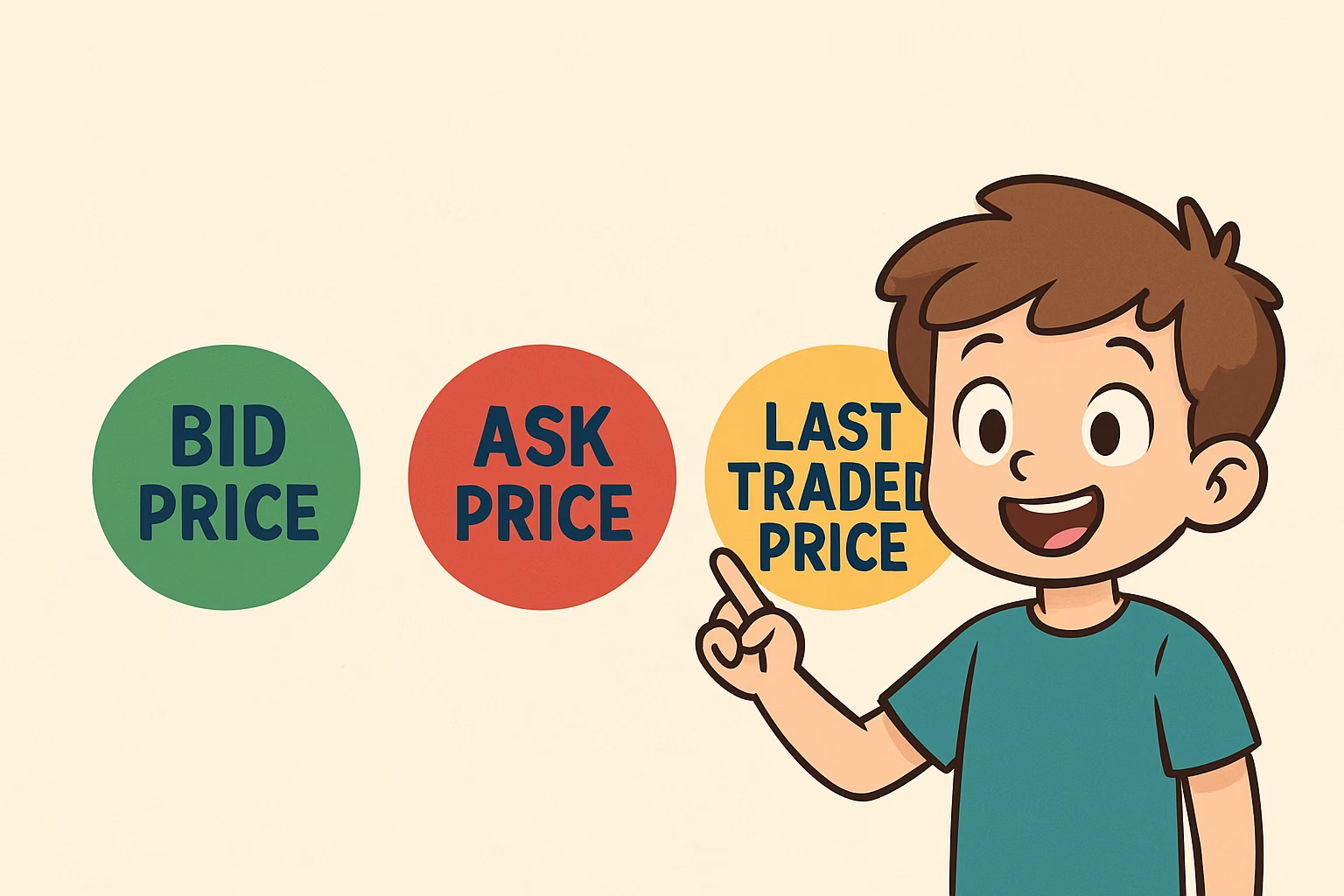
When there are no sellers at ₹50 but someone is willing to sell at ₹52, the price may rise. Likewise, if buyers only offer ₹48, the price may fall. The current price—also called the market price—is the last agreed‑upon price between a buyer and a seller.
How Are Stock Prices Determined?
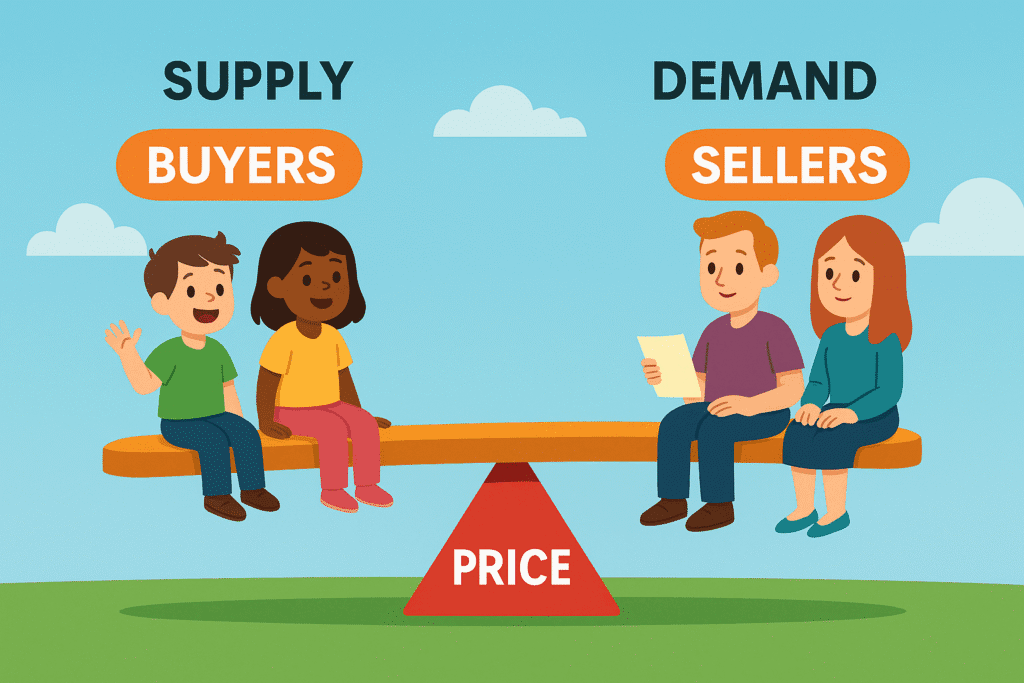
Prices change all the time because of supply and demand. The stock market works like a giant auction. When many investors want to buy a stock (high demand) and few want to sell (low supply), the price goes up. When many want to sell and few want to buy, the price falls.
The relationship between supply and demand applies to markets in general. According to a simple explanation of supply and demand for kids, supply refers to how much of something is available, and demand refers to how much people want it. If demand increases while supply stays the same, prices go up; if demand decreases while supply stays the same, prices go down. Similarly, if supply increases while demand stays the same, prices fall; if supply decreases, prices rise. Stores set prices and stock levels based on supply and demand.
The Ask and the Bid
Two important terms are ask and bid. The ask is the lowest price a seller is willing to accept. The bid is the highest price a buyer is willing to pay. When the ask equals the bid, a trade happens, and that price becomes the market price.
Other Factors That Influence Prices
Although supply and demand are the primary drivers, many other factors influence stock prices:
- Industry performance: If entire industries (like technology or food) do well, stocks in that industry may rise.
- Company news: Good news (e.g., new product, big contract) can raise demand and push up the price; bad news (e.g., scandals, recalls) can reduce demand and cause prices to drop.
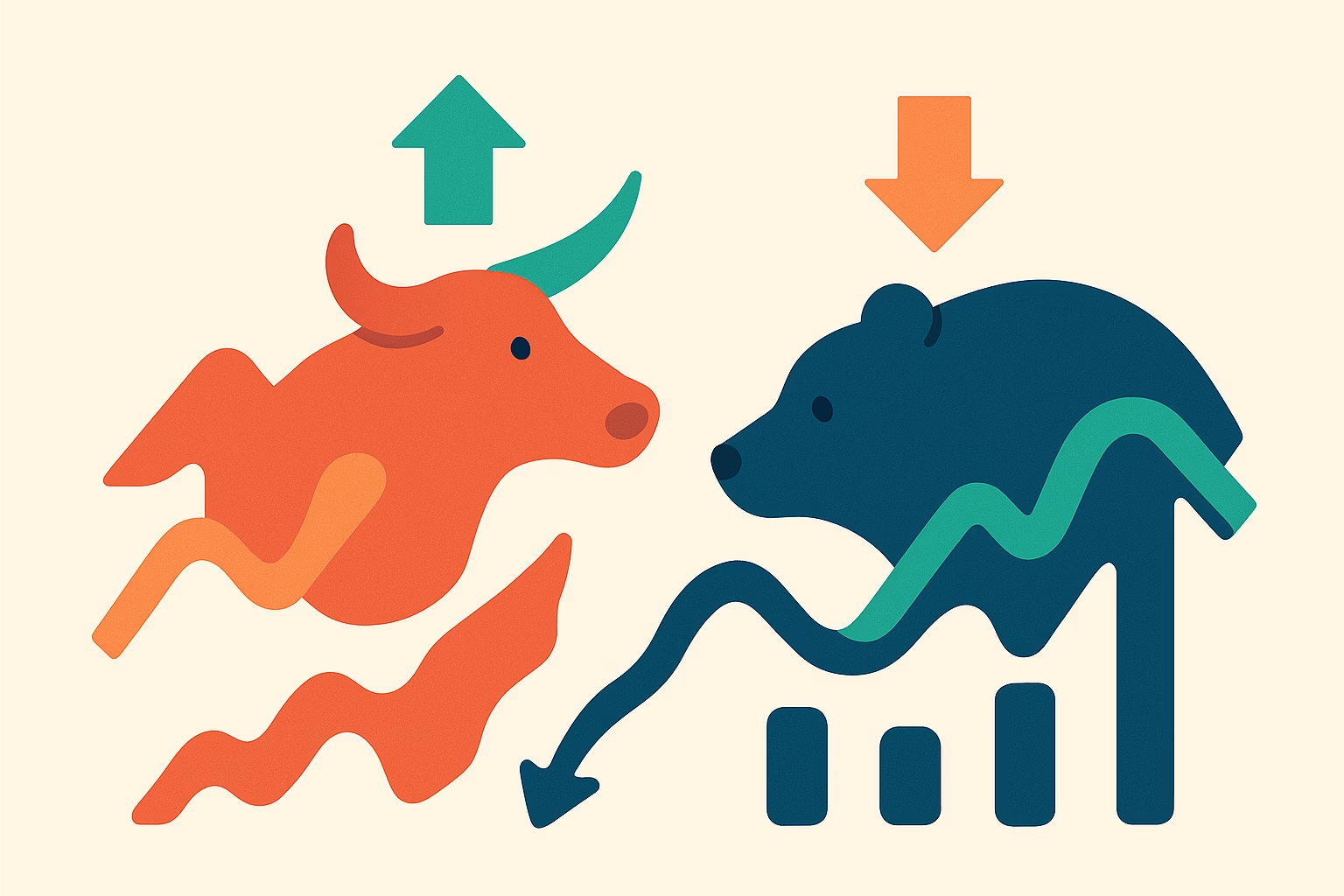
- Investor mood: When investor confidence is low, prices may fall, creating a bear market. When confidence is high, prices may rise, creating a bull market.
- Economic or political events: Shocks like natural disasters or elections can temporarily destabilize markets.
Two Main Types of Market Players
- Investors
These individuals buy shares intending to hold them for a long time. They believe the company will grow and reward them with dividends and higher stock prices. Investors focus on company fundamentals—profits, growth prospects and management quality—and often ignore short‑term price fluctuations.
- Traders
Traders buy and sell quickly, sometimes in minutes or days, hoping to profit from short‑term price movements. They spend much time studying price charts and market patterns. Trading can be exciting but also risky.
Some people do a little of both—investing long term while occasionally trading short term.
Common Stock Market Words (Made Simple)
| Term | Simple Meaning | Relation to Stock Market |
| Broker | A service or app that buys or sells shares for you | You need a broker to trade stocks |
| Portfolio | Your personal basket of different investments | Holds all the stocks, funds or bonds you own |
| IPO | The first sale of a company’s shares to the public | Like selling slices of a new lemonade stand |
| Dividend | A portion of a company’s profit paid to shareholders | Extra money you receive for owning the stock |
| Bull Market | A period when investor confidence is high and prices tend to rise | Symbolized by a bull pushing prices up |
| Bear Market | A period when investor confidence is low and prices tend to fall | Symbolized by a bear pushing prices down |

How Do You Start Investing?
Starting is easier like ordering a video game online. Here are the basic steps:
- Open a Demat & Trading Account – In India, you need a dematerialized (Demat) account to hold your shares electronically, and a trading account to place buy or sell orders. Many brokers (like Zerodha, Groww or Upstox) let you open these accounts online.
- Add Money – Transfer money from your bank account into your trading account. Only use money you won’t need soon (for example, don’t use your school fees or rent).
- Place Your Order – Search for the company’s stock symbol (for example, “RELIANCE” for Reliance Industries), choose how many shares you want, and click Buy. When you’re ready to sell, click Sell.
That’s it! Your shares will appear in your Demat account. If you sell, the money goes back into your trading account.
Different Ways to Invest
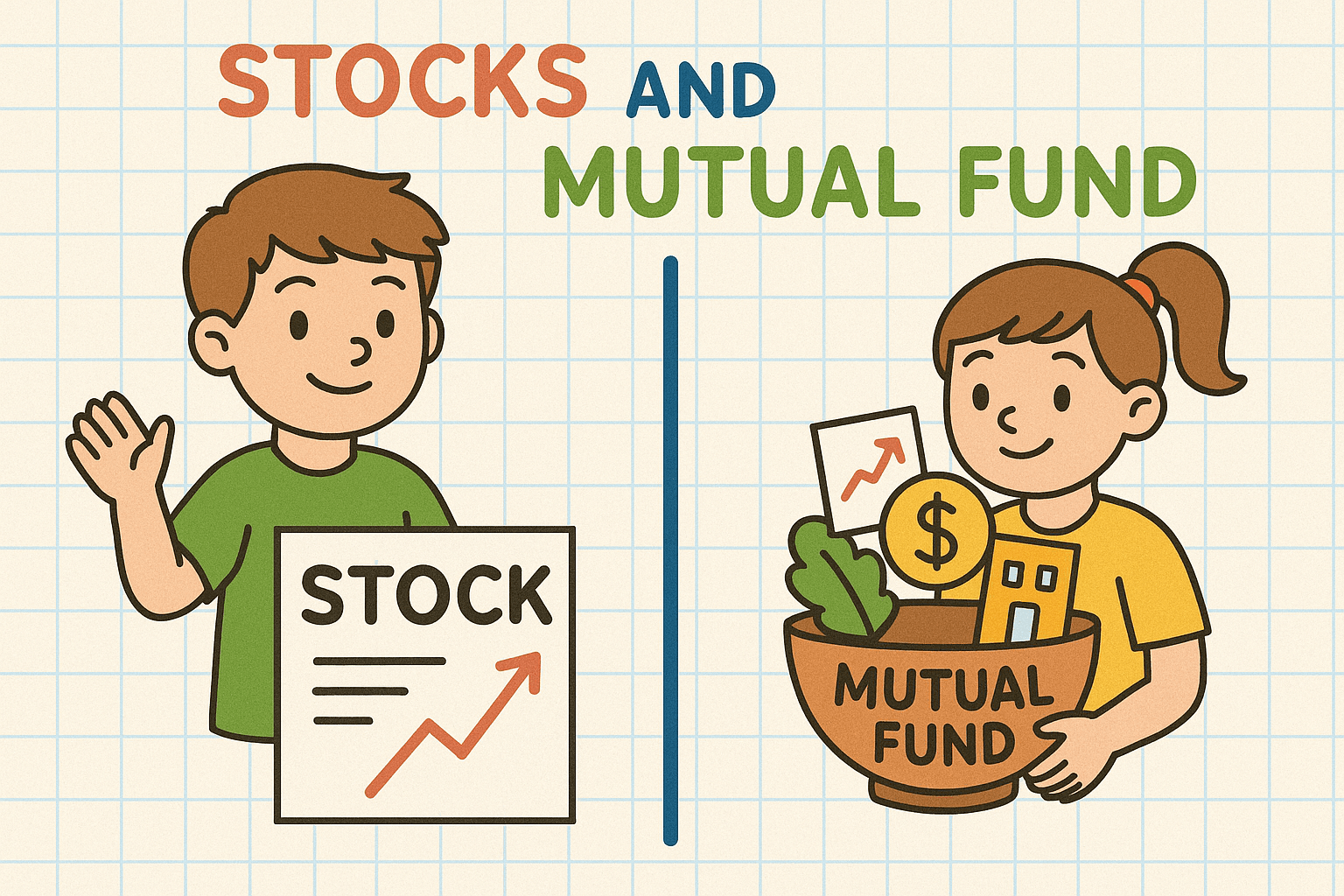
- Buying Individual Stocks – You pick specific companies you believe will grow. This can be rewarding but also risky because if the company performs poorly, your investment may lose value.
- Mutual Funds – Think of a mutual fund like a fruit salad. Instead of eating just apples or oranges, you get a mix of many fruits. A mutual fund pools money from many investors to buy a diversified set of stocks or bonds. Professional fund managers choose the investments. This spreads the risk.
- Index Funds/Exchange‑Traded Funds (ETFs) – These funds aim to mimic a broad market index such as Nifty 50 or S&P 500. They’re like a huge fruit basket containing every fruit in a market. Index funds are considered one of the easiest ways to start investing because they automatically track the market.
- Recurring Deposits and Bonds – Though not part of the stock market, some investors also put money in government bonds or bank deposits for safety. It’s wise to balance riskier stock investments with safe instruments.
How Do People Make Money?

There are two primary ways to earn from stocks:
- Capital Gains – You buy at one price and later sell at a higher price. For example, you buy a share at ₹100. If its price rises to ₹150, you make ₹50 profit. This is called a capital gain.
- Dividends – Companies sometimes share part of their profits with shareholders. Dividends are extra money you get for owning the stock. They may be paid once or several times a year.
Not all companies pay dividends. Some reinvest all profits back into the business to fuel growth. These firms might still offer capital gains if the stock price rises.
But Remember: Prices Can Fall
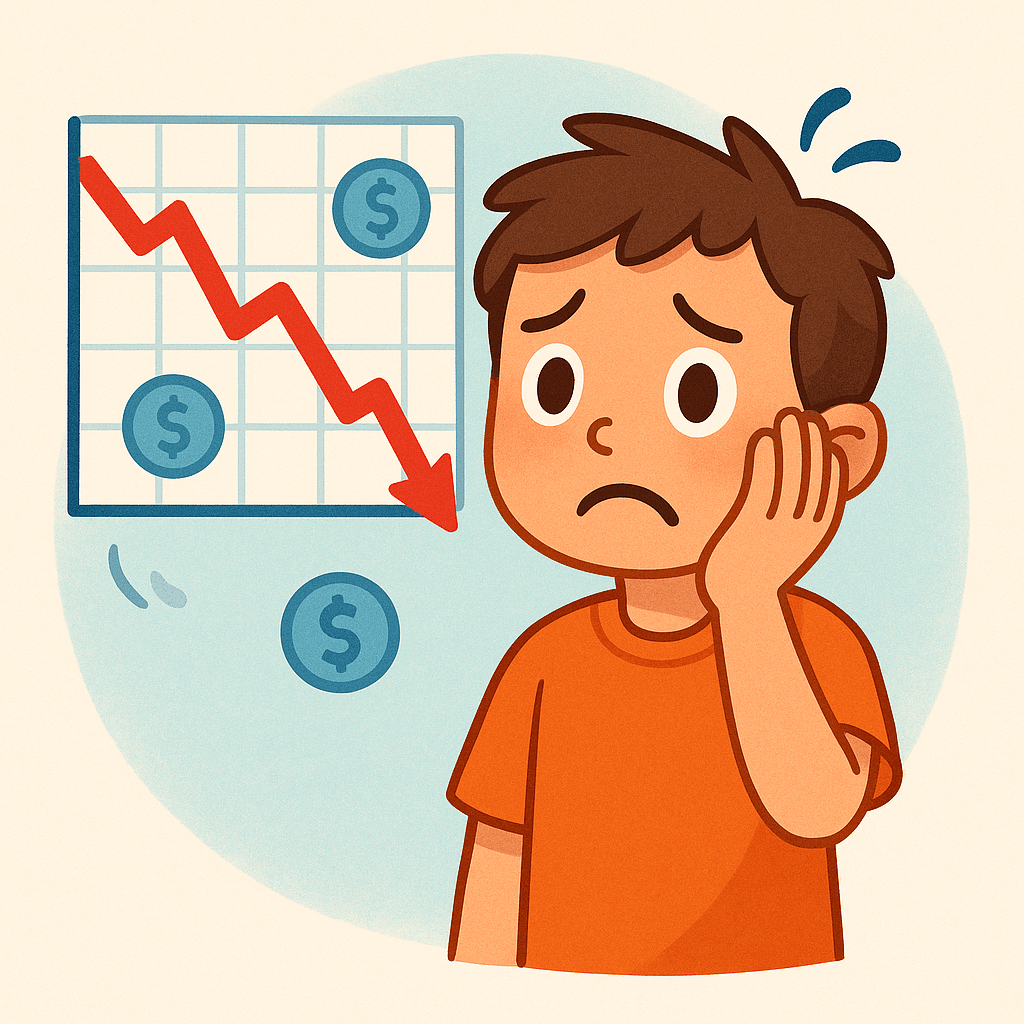
The stock market isn’t a magic money machine. Prices can go up or down. Never invest money you need for urgent expenses. If you panic when prices fall and sell, you might lock in losses. That’s why it’s important to invest only what you can leave untouched for several years.
Smart Habits for Beginners
- Start Small – Begin with a modest amount. As you learn, you can increase your investment.
- Invest Regularly – Adding money to your portfolio every month (called a Systematic Investment Plan or SIP) helps you build wealth over time. It averages out the cost of shares.
- Learn Continuously – Read simple books, watch educational videos, and follow trustworthy financial websites. Understand what you’re buying.
- Be Patient – Most fortunes are made over years, not days. Patience is a key ingredient to successful investing.
- Diversify – Don’t put all your money into one stock. Spread your investments across different companies or funds. This reduces risk because if one company performs poorly, others may perform better.
Stock Market vs. Bank Savings
| Feature | Bank Savings | Stock Market |
| Risk Level | Low risk. Money is usually insured by the government and the balance doesn’t fluctuate. | Higher risk. Prices can go up or down day to day. |
| Return Potential | Usually lower interest rates. Good for emergency funds. | Potentially higher returns over the long run. |
| Flexibility | Easy to withdraw anytime. | Must sell stocks to get cash; may take a day or two. |
| Purpose | Safe storage of money needed soon (e.g., for emergencies). | Growing wealth over many years. |
It’s wise to keep some money in a savings account for emergencies and invest the rest for long‑term goals.
Fun Example – Lemonade Stand IPO and Markets
Let’s return to our lemonade stand. Suppose your stand becomes popular and you need to expand. You decide to raise money by selling 100 shares at ₹10 each. Your friend buys 10 shares for ₹100. This initial sale is called the primary market—the first time shares are sold to investors.
Later, your friend decides to sell those shares to another classmate. This trade happens on the secondary market. The company doesn’t get this money; the money goes from one investor to another. Both markets are essential: the primary market helps companies raise money to grow, and the secondary market provides liquidity—people can easily buy and sell shares.
If your lemonade stand starts earning more money, demand for its shares may increase and the price may go up. If demand falls (perhaps your recipe isn’t as tasty), the price may drop. Investors must consider supply and demand when buying or selling shares.
A Glimpse of History
The idea of people pooling money to fund business ventures is old. The first stock exchange is often traced back to the Dutch East India Company in the early 1600s. Investors could buy pieces of the company, helping to finance voyages to Asia. Over time, other countries created their own exchanges. In India, the Bombay Stock Exchange (BSE) started in 1875 and is one of the oldest in Asia. Modern technology has made trading accessible to nearly anyone with a smartphone.
Final Safety Tips
- Do your homework. Before investing in any company, learn about its business, profits, debts and future plans.
- Avoid herd mentality. Don’t buy or sell just because everyone else is. Make informed decisions.
- Invest for the long term. The longer you stay invested, the more time your money has to grow and recover from market dips.
- Set goals. Know why you’re investing (education, a house, retirement). Goals help you decide how much risk to take.
- Stay calm during market swings. Prices will go up and down. Staying calm and sticking to your plan is crucial.
Conclusion – Your Journey as a Future Investor

The stock market might seem complicated, but it’s essentially a place where people buy and sell pieces of companies. By understanding simple concepts like stocks, stock exchanges, supply and demand and the difference between long‑term investing and short‑term trading, you can start your investing journey with confidence. Remember the pizza and lemonade examples: owning a slice makes you part of something bigger, and selling shares helps businesses grow.
Learning to invest is like planting a seed. With patience, knowledge and consistent care, it can grow into a tree that bears fruit in the future. Whether you dream of owning a lemonade empire, supporting innovative companies or simply building wealth for your goals, the stock market offers a path to reach those dreams. Use your newfound knowledge wisely, keep learning and enjoy the adventure of becoming a smart investor!