
Table of Contents
By understanding the basics of and the difference between value investing vs growth investing, kids and adults can learn how to make smart choices with their money. This article explains the concepts in simple words, compares the two styles, and uses examples from India and the United States. The illustrations will help you remember the key ideas.
What Is Investing?

Investing is like planting seeds to grow new plants. When you invest, you use your money (often called capital) to buy something that you hope will be worth more in the future. Adults invest by buying stocks, which are tiny pieces of a company. When the company does well, your piece becomes more valuable.
In India, stocks are bought and sold on the Bombay Stock Exchange and the National Stock Exchange. In the United States, people use stock markets such as the New York Stock Exchange and NASDAQ. No matter where you live, investing can help your money grow over time.
Two Ways to Think About Stocks
1. Growth Investing — the Rocket Ship

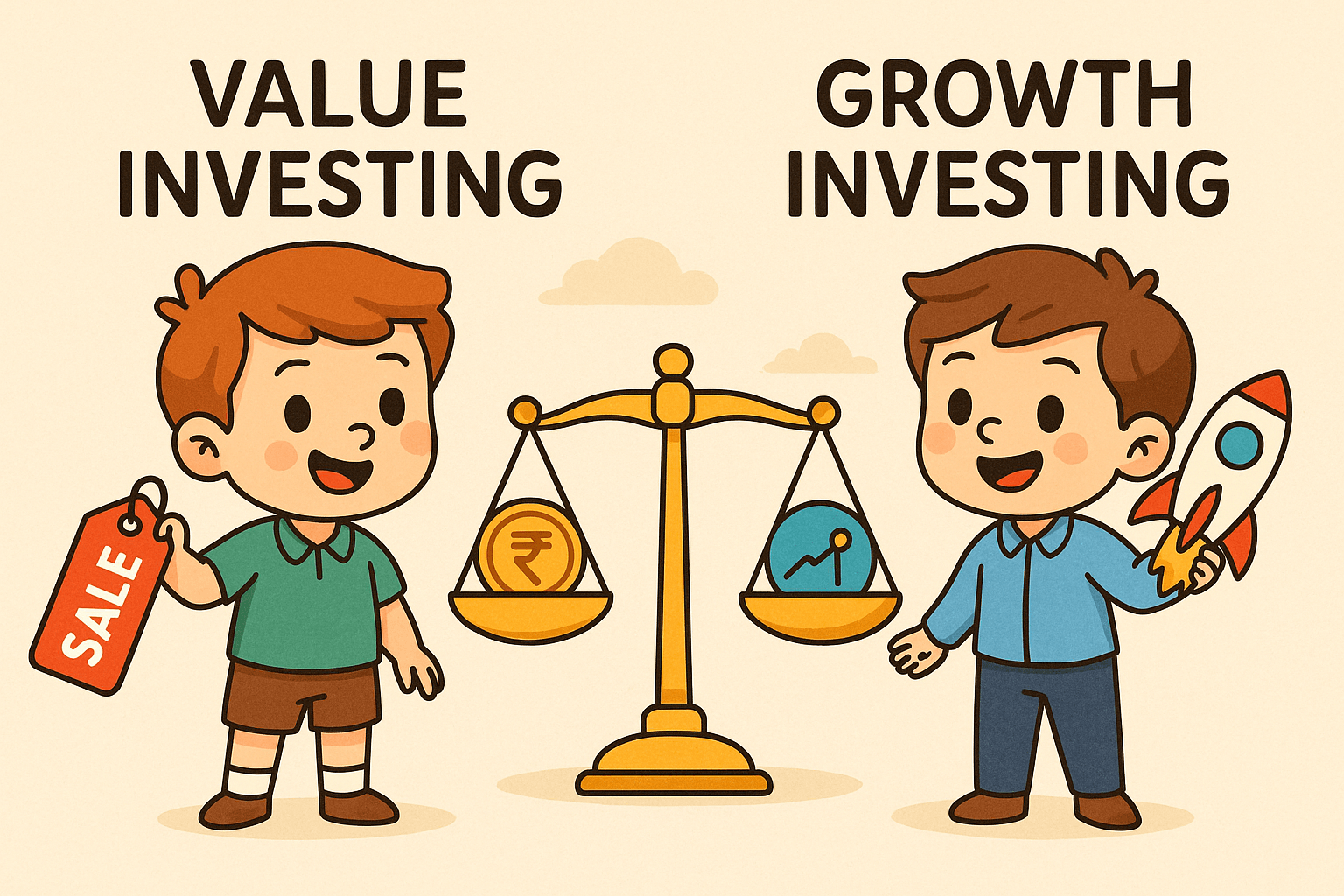
Growth investing is like buying a rocket toy because you believe it will become super popular. Growth investors look for companies that are growing quickly, often in new industries such as technology and digital services. These companies reinvest most of their profits to grow even bigger instead of paying cash back to investors.
- In growth investing, price matters less at the beginning. Investors pay a higher price because they expect the company to grow a lot. According to investing guides, growth stocks often have above‑average price‑to‑earnings ratios and low or no dividends, reflecting investor confidence that profits will expand.
- Growth companies can be volatile — their prices go up and down quickly. This strategy is riskier because if the company does not grow as expected, the price can drop.
- Examples from India: Bajaj Finance, Reliance Industries, Zomato and other technology or fintech companies are often called growth stocks. These businesses innovate quickly and try to dominate their markets.
- Examples from the United States: Amazon, Netflix and Tesla are classic growth stocks because investors expect them to keep expanding rapidly.
2. Value Investing — the Treasure Hunt

Value investing is like buying a toy on sale because you know its true value. Value investors look for companies that are currently cheap compared to what they are really worth. This might happen because of temporary problems or because other investors have overlooked them.
- Value stocks usually have low price‑to‑earnings (P/E) ratios and high dividend yields. They are mature businesses that earn steady profits and often reward investors with regular payments.
- Value investing focuses on capital preservation — protecting your money while still allowing it to grow. It is generally less risky than growth investing because you buy at a lower price.
- Examples from India: State Bank of India, Coal India Ltd., Bharat Petroleum Corporation and Power Grid Corporation of India are considered value stocks because they are large, established companies trading at lower valuations. bajajfinserv.in
- Examples from the United States: Companies like Procter & Gamble (which makes household products) and JPMorgan Chase (a big bank) are often viewed as value stocks.
Comparing Growth and Value – A Simple Table
Below is an easy‑to‑read table comparing key features of growth and value investing. The terms P/E ratio and P/B ratio refer to ways that investors measure how expensive a stock is compared to its earnings (P/E) or assets (P/B).
| Feature | Growth Investing | Value Investing |
|---|---|---|
| Goal / Philosophy | Invest in young companies that grow fast and can change industries. | Invest in strong companies currently priced below their true value. |
| Price of Stock | Usually high because many investors expect big growth. | Usually low because the market has ignored or undervalued the company. |
| Risk / Volatility | Higher risk; prices swing quickly with news and expectations. | Lower to medium risk; prices are more stable and often less volatile. |
| Dividends | Low or no dividends; money is reinvested to grow. | Higher and more consistent dividends, rewarding investors regularly. |
| P/E & P/B Ratios | High P/E and P/B ratios show the market’s optimism. | Low P/E and P/B ratios indicate that the stock may be cheap. |
| Best Market Conditions | Often perform better in bull markets (when stocks in general are rising). | Often perform better in bear markets or downturns. |
| Examples (India) | Bajaj Finance, Reliance Industries, Zomato. | State Bank of India, Coal India Ltd., Power Grid Corporation. |
| Examples (US) | Amazon, Netflix, Tesla. | Procter & Gamble, JPMorgan Chase. |
When Does Each Style Shine?

Markets move in cycles. Sometimes the economy is booming (bull market), and sometimes it slows down (bear market). Research shows that growth stocks tend to outperform during boom periods, while value stocks often do better in downturns.
Imagine a ride in an amusement park. Growth investing can feel like a roller coaster — thrilling when the ride goes up and scary when it dips. Value investing feels more like a merry‑go‑round — slower and smoother, with smaller ups and downs. Both rides are fun, but you might prefer one depending on how much excitement you can handle.
Why Not Use Both?
Most financial teachers say you don’t have to pick just one style. According to the NerdWallet guide, growth and value investing are not opposites; they can work together in the same portfolio. nerdwallet.com By mixing growth and value stocks, you can diversify your investments — just like putting different fruits in a basket. Some fruits may ripen quickly (growth stocks), while others stay tasty longer (value stocks).
How Do Growth Investors Think?

To understand growth investing, think of a company as a young tree. Growth investors believe the tree will someday be huge. They look at things like:
- Rapid revenue or profit growth: The company’s sales and earnings are increasing faster than the industry average.
- Innovation and market leadership: Growth companies are often innovators that use technology to lead their sector.
- High valuations: Growth stocks trade at high P/E and P/B ratios, meaning investors pay more today for future profits.
- Low dividends: The company reinvests profits to grow instead of paying cash to investors.
These investors hope that the tree will grow tall quickly. If it does, their investment could soar like a rocket. But if the tree doesn’t grow as expected, the price may fall.
Indian Examples
Bajaj Finance is a non‑bank financial company that has grown rapidly by offering easy loans and digital payment solutions. Its profits have increased fast, so investors expect continued growth. Another example, Zomato, delivers food using a mobile app and has expanded quickly across India. Growth investors are excited by their potential.
American Examples
In the United States, Amazon started as an online bookstore and now sells almost everything. Its revenue growth has been strong for years. Tesla sells electric cars and invests in cutting‑edge technology. These companies often reinvest profits to develop new products, so they fit the growth‑investing style.
How Do Value Investors Think?
Value investors see investing like a treasure hunt in a thrift shop. They try to find good items that other people have ignored. Here’s what they look for:
- Low prices relative to earnings: They prefer stocks with low P/E ratios because it suggests the stock is cheaper than average.
- High dividends: Value companies often pay regular dividends, rewarding investors for holding the stock.
- Strong fundamentals: A value company has solid profits, low debt and a stable business model.
- Temporary problems or undervaluation: Sometimes a company’s stock price drops because of short‑term issues like negative news or a slow economy. Value investors believe the price will recover once the problems pass.
Indian Examples
State Bank of India (SBI) is India’s largest bank. Even though it is huge, its share price sometimes trades at a lower P/E ratio. SBI pays regular dividends and has weathered many economic cycles. Coal India Ltd. produces coal and has stable demand; because it’s less trendy than tech companies, it often trades at a low price. bajajfinserv.in These companies fit the value style.
American Examples
In the United States, Procter & Gamble makes household items such as soap and toothpaste. People need these products regardless of the economy, so the company earns steady profits and pays dividends. JPMorgan Chase, a big banking group, is also considered a value stock because it is well established and trades at lower valuations.
Market Cycles – Bull vs Bear

Markets don’t move in a straight line. They go through bull markets (prices are rising) and bear markets (prices are falling). Growth stocks usually outperform in bull markets because investors are excited about the future. Value stocks often do better in bear markets, when investors look for safety.
Think about when the monsoon season arrives in India or when winter comes in the US. Farmers plant certain crops for each season because some crops thrive in rain while others prefer dry weather. Similarly, different investing styles do better in certain market conditions.
How to Decide Which Style Fits You

Even though this article is written so that children can understand, the ideas can help adults too. Here are some questions to think about when choosing between growth and value investing:
- How much risk can you handle? If sudden swings make you nervous, value stocks might feel safer because they are less volatile. If you are comfortable with ups and downs, growth stocks can offer bigger rewards but also bigger risks.
- What is your time horizon? Growth investments often need patience because companies take time to expand. Value investing may pay dividends sooner, but it can take a while for the market to recognize the company’s true value.
- Do you want regular income? Value stocks often pay dividends, which can provide income. Growth stocks usually don’t pay much, because they reinvest profits.
- Are you researching properly? Both styles require learning about companies. Growth investors study future potential and innovation; value investors read financial statements to estimate a company’s real worth.
No matter what you choose, remember to diversify—spread your money across different types of stocks so that one bad investment doesn’t ruin everything. As the NerdWallet article points out, mixing growth and value strategies can make your portfolio more balanced nerdwallet.com.
Tips for Young Investors

- Start small and save regularly: Putting away even small amounts of pocket money can grow over time.
- Use “piggy bank investing”: Just like saving coins in a piggy bank, you can start with safe, low‑cost mutual funds (in the US) or Systematic Investment Plans (in India) under adult supervision.
- Learn before you leap: Before buying a stock or mutual fund, read about the company and ask trusted adults for advice.
- Think long term: Investing is not about getting rich quickly. It’s about planting seeds today for fruit tomorrow. Even value investments require patience.
- Mix it up: Don’t put all your money in one company. Having a mix of growth and value investments can smooth out the ride.
Final Thoughts

Both value investing and growth investing are ways to make your money work for you. Growth investing is like a rocket — exciting and sometimes scary — while value investing is like finding a hidden treasure in a thrift store. The choice between the two depends on your goals, how much risk you are comfortable with, and how long you want to wait.
For a 10‑year‑old learning about investing, understanding these styles is a great first step. No matter where you live — Ghāziābād, New York or anywhere in between — the basic ideas remain the same: invest in what you understand, be patient and always keep learning.
We hope this guide helps you make better decisions and inspires you to explore the world of investing. Remember: investing carries risks, and you should consult a parent, guardian or financial advisor before making any investment decisions.
If You Liked This Article, Then You Might Also Like This –
Moat: How Competitive Advantage Matters





One comment on “Value Investing vs Growth Investing: A Kid‑Friendly Guide”