
Table of Contents
Understanding options can seem scary if you’ve never heard of them before, but they’re simply contracts people use to buy or sell things at agreed‑upon prices. In this article we’ll explore What are Options ? including call options and put options in plain language.
We’ll use examples from both India and the United States, so families in Delhi or New York can follow along. Even if you’re ten years old or just starting to learn about money, you’ll be able to understand how options work, the benefits and risks, and why some investors use them.
A Quick Look at Options Contracts

An option is a financial contract that gives its buyer the right but not the obligation to do something later. That “something” could be buying or selling a stock, an index like NIFTY (India’s leading stock market index), a commodity like gold, or even a basket of 100 shares in an American company.
Important option terms
- Underlying asset – the thing the option is tied to (e.g., a stock like Reliance Industries in India or Apple in the U.S.).
- Strike price – the price at which the option allows you to buy or sell the underlying asset.
- Expiration date – the last day the option can be used. After this date, the contract is worthless.
- Premium – the price you pay (if buying an option) or receive (if selling) for the contract.
- In the Money (ITM), At the Money (ATM), Out of the Money (OTM) – describe whether the underlying price is above, equal to, or below the strike price.
Options are standardized, which means one contract usually controls a specific number of shares—100 shares in the United States or 25 shares for NIFTY contracts in India. groww.in Buyers can let the contract expire if it won’t benefit them; the most they can lose is the premium they paid.
Why use options?

Investors use options for three main reasons:
- Speculating – making a bet on whether prices will go up or down. Buying calls is a bullish bet (hoping prices rise), while buying puts is bearish (expecting prices to fall).
- Hedging – using options as insurance to protect existing investments. Buying a put can limit losses on shares you already own.
- Generating income – selling options to earn a premium, such as writing covered calls if you own shares.
Below we’ll explore the two types of options—call options and put options—and illustrate how they work with stories and examples.
Call Options: The Right to Buy

A call option gives the buyer the right (but not the obligation) to buy an asset at a pre‑agreed strike price within a specified time. Think of it like a coupon that lets you buy something in the future at today’s price. You pay a small fee—the premium—for that coupon.
If the market price goes above the strike price before the expiration date, you can use your coupon to buy at the lower price and either keep the asset or sell it for a profit. If the market price stays lower than the strike price, you let the coupon expire and lose only the premium.
How call options work (simple example)
Imagine your friend Riya in Ghāziābād wants to buy a new smartphone that currently costs ₹20,000. She thinks the price will rise because of high demand. The store offers a coupon (option) that allows her to buy the phone for ₹20,000 any time in the next month for a small fee of ₹500.
This coupon is like a call option.
If the price jumps to ₹22,000, Riya uses her coupon and buys at ₹20,000, saving ₹2,000 minus the ₹500 fee (net ₹1,500). If the price stays below ₹20,000, she simply doesn’t use the coupon and only loses the ₹500 fee.
Formal definition and key characteristics
A call option gives its owner the right, but not the obligation, to buy the underlying security at a specific price on or before a specific date. Each contract normally represents 100 shares in the U.S. or 25 shares in Indian indices like NIFTY. The option buyer’s maximum loss is limited to the premium.
Example from India (Reliance Industries)
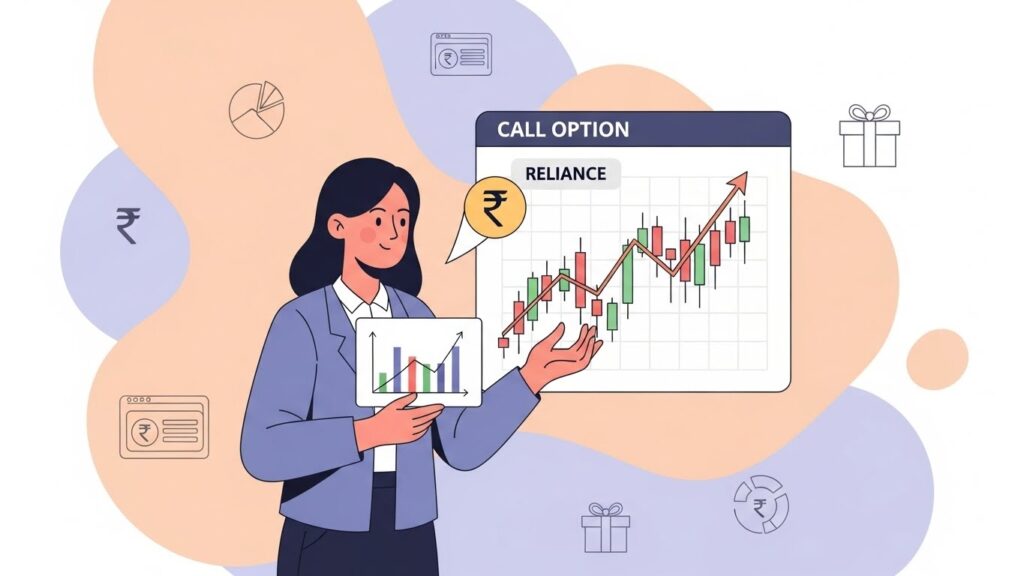
Let’s see how call options work on an Indian stock. Suppose an investor in Mumbai believes Reliance Industries’ share price (currently ₹2,200) will rise within a month. She buys a call option with a strike price of ₹2,300 for a premium of ₹50 per share. Each contract covers 100 shares. There are two possible outcomes:
- Stock price rises to ₹2,400: She exercises the option, buys shares at ₹2,300 and sells them at ₹2,400. Her profit is ₹100 per share minus the ₹50 premium, so she makes ₹50 per share.
- Stock price stays below ₹2,300: She lets the option expire. Her maximum loss is the premium of ₹50 per share.
This example shows how call options offer a cheaper way to bet on price increases than buying the shares outright. If you bought 100 shares at ₹2,200, you’d need ₹2,20,000. With the call, you pay only ₹5,000 (₹50×100) for the right to control 100 shares.
Example from the United States (Apple stock)

Now consider a teenager in California who loves Apple products. Apple’s stock trades at $188. She thinks it might rise, but she doesn’t have $18,800 to buy 100 shares. Instead she buys a call option with a strike price of $200 for $2.69 per share. schwab.com The contract gives her the right to buy 100 shares at $200 anytime before expiration. Two scenarios:
- Apple’s price rises above $202.69: She can sell the call in the market or exercise it to buy shares at $200 and sell at the higher market price. Her profit will be the difference between the stock price and the breakeven price ($200 + $2.69 premium).
- Apple’s price stays below $200: She loses the entire premium ($269), which is less than the cost of buying 100 shares.
The key takeaway is that call options allow investors with limited capital to profit from potential increases while limiting losses to the premium.
When might you buy a call?
- When you expect the stock or index to rise and want a cheaper way to benefit.
- When you wish to reserve the right to buy shares later but are not sure yet.
- When you want leverage—the possibility of high percentage returns with a smaller initial outlay.
Risks of call options

Although calls limit losses to the premium, they also have risks:
- Time decay: Options lose value as they near expiration. If the expected price rise doesn’t happen quickly, the call may become worthless.
- Volatility: If the underlying price stays flat, the option may still lose value because of time decay or lower volatility.
- Limited life: Unlike owning shares, options expire. If the stock moves in your favor after the expiration date, the call will not benefit you.
Put Options: The Right to Sell

A put option is like a protection plan that gives the buyer the right (but not the obligation) to sell an asset at a pre‑agreed strike price before a specific date. groww.in It works like insurance: you pay a premium, and if the price drops below the strike price, you can sell at the higher strike price and avoid losses. If the price stays high, you let the contract expire and lose only the premium.
How put options work (simple example)
Imagine you own a bicycle worth ₹5,000 and worry it might lose value. Your friend offers an insurance coupon (put option) that, for ₹200, allows you to sell your bicycle for ₹5,000 within the next month. If the bike’s price falls to ₹4,000, you can still sell it to your friend for ₹5,000. If the price stays above ₹5,000, you wouldn’t use the coupon, and your loss is the ₹200 premium.
Formal definition and characteristics
A put option gives its owner the right, but not the obligation, to sell the underlying security at a specific price on or before the expiration date. The buyer uses it if the underlying price falls below the strike price; otherwise the option expires worthless.
Example from India (NIFTY Put Hedge)

Suppose you hold a portfolio of Indian stocks and want protection against a potential decline. The NIFTY index stands at ₹20,300, and you expect it might fall to ₹20,000. You buy an in‑the‑money put option on NIFTY with a strike price of ₹20,300 at a premium of ₹150 per unit, with a lot size of 25. Two scenarios:
- NIFTY falls to ₹20,000: The put’s intrinsic value is ₹300 (₹20,300 – ₹20,000). After subtracting the ₹150 premium, the net gain is ₹150 per unit. Multiplying by the lot size (25), you earn ₹3,750. This gain can offset losses in your stock portfolio.
- NIFTY stays at ₹20,200: The intrinsic value is ₹100. After subtracting the premium, you would lose ₹50 per unit, or ₹1,250 per contract.
- NIFTY rises above ₹20,300: The put expires worthless, and your loss is limited to the premium.
This example shows how a protective put can limit downside risk. It’s like paying for insurance; if the market falls, your put compensates you; if it doesn’t, you only lose the premium.
Example from the United States (Protective Put on a Stock)

Consider a U.S. investor who owns shares of a stock trading at $79.34 and is worried it might fall below $77.50. They buy a put option with a strike price of $77.50 for $2.76 per share. If the stock falls below $77.50 before expiration, the investor can exercise the put and sell shares at $77.50. Their maximum loss is capped at the strike price minus the premium. schwab.com
This is known as a protective put: it provides downside protection while allowing the investor to remain exposed to upside gains.
When might you buy a put?
- When you expect the stock or index to fall and want to profit from the decline.
- When you own shares and wish to protect against a loss by locking in a sale price.
- When you speculate that a stock is over‑priced but don’t want to short sell (which can have unlimited risk).
Risks of put options
- Premium cost: If the stock doesn’t fall, the option expires worthless and you lose the premium.
- Timing: If the price decline happens after the option expires, you gain nothing.
- Volatility: Options are sensitive to changes in volatility; if volatility drops, the put’s value can decrease even when the stock price is unchanged.
Comparing Call & Put Options

| Option type | Right granted | When used | Profit if… | Maximum loss |
|---|---|---|---|---|
| Call option | Right to buy an asset at a predetermined price | Used when you expect prices to rise | Price of the underlying asset is higher than the strike price + premium paid | Limited to the premium paid |
| Put option | Right to sell an asset at a predetermined price | Used when you expect prices to fall or want protection | Price of the underlying asset falls below the strike price | Limited to the premium paid |
The choice between a call and a put depends on your expectations about price direction. Calls profit from upward moves, while puts profit from downward moves or provide insurance.
Option Writing: Selling Calls and Puts

So far we’ve discussed buying options. Writing or selling options is the other side of the contract. The seller (also called the writer) collects a premium upfront but takes on the obligation to buy or sell the underlying if the buyer exercises the option.
Covered call writing
A popular strategy in the U.S. and India is the covered call. You sell a call option on a stock you already own to earn extra income. For example, an investor holding 100 shares of a stock trading at $79.34 might sell a call with a strike price of $82.50 and collect $2.37 per share.
If the stock stays below $82.50 by expiration, the option expires worthless and the seller keeps both the stock and the premium. If the stock rises above the strike price, the seller may have to sell the shares at $82.50 but still keeps the premium.
Selling put options
Selling a put option means you agree to buy the underlying asset if the buyer wants to sell. Sellers of puts collect a premium but can be obligated to buy shares if the price falls below the strike price.
Selling puts is riskier because the stock could fall significantly, though your loss is limited to zero if the company goes bankrupt (because you cannot lose more than the cost of the stock you must buy). You can think of selling puts like promising to buy a product at a certain price if it goes on sale; you get paid for that promise, but you must buy if the product’s price drops.
Time Value and Intrinsic Value

An option’s premium consists of two components: intrinsic value and time value.
- Intrinsic value is the difference between the underlying asset’s price and the strike price when the option is in the money. If the option is out of the money or at the money, intrinsic value is zero.
- Time value is the extra amount you pay over intrinsic value for the possibility of future gains. Time value decreases as the expiration date approaches, a phenomenon called time decay.
Understanding these concepts helps investors evaluate whether an option is fairly priced.
Practical Tips for Beginners

Here are some simple guidelines for people just starting to explore options:
- Learn the basics – Understand how calls and puts work, what strike prices and expiration dates mean, and how premiums are determined.
- Start small – Use options with smaller premiums and short durations. In India, NIFTY options have low premiums that allow beginners to practice.
- Use options to manage risk – Consider protective puts if you hold stocks and want insurance.
- Be mindful of costs – Transaction costs and premiums can add up. Compare the potential reward with the cost.
- Never invest money you can’t afford to lose – Options can expire worthless if the price does not move in your favor.
- Seek guidance – Many brokers offer educational resources. For example, Vanguard and Charles Schwab provide in‑depth explanations of call and put options.
Why Options Matter in India and the U.S.
Options trading is popular in both India and the United States, but markets operate slightly differently:
- In India, stock options are traded in standardized lots (usually 25 units for NIFTY), and you need a demat account. People often use call and put options on indices like NIFTY or stocks like Reliance or Tata Motors. The examples above showed how a call option on Reliance or a put option on NIFTY works.
- In the United States, most options contracts represent 100 shares. Options are used widely by retail investors to speculate or hedge. American options can be exercised anytime before expiration, while some index options in India are European style and can only be exercised on the expiration date.
Understanding these differences is important if you plan to trade options in either country.
Conclusion

Options might sound complicated, but at their core they’re flexible contracts that give people the right to buy or sell an asset at a predetermined price within a set period.
Call options are like coupons to buy something later at today’s price; they can be used to profit from upward price movements or to reserve the right to buy an asset.
Put options are like insurance, allowing you to sell an asset later at today’s price; they can protect you from price drops or let you profit from falls. Whether you’re in Delhi buying a call on NIFTY or in New York buying a protective put on a U.S. stock, the basic principles are the same: options give you flexibility, limited risk, and potential leverage.
However, they also require careful study and an understanding of how time, volatility, and market movements can affect their value.
By starting with small positions, using options for hedging, and always being aware of the premium you pay, you can explore this fascinating world of options trading safely. With practice, the concepts of call and put options become as easy as using a coupon or buying insurance, and they can be a powerful tool in any investor’s financial toolkit.
📌 Disclaimer
I am not a SEBI-registered investment advisor or analyst. The information shared in this article is meant purely for educational and awareness purposes and should not be considered as financial, investment, or trading advice.
Any stocks, sectors, or companies mentioned here (such as Reliance Industries, Apple etc.) are only examples used to explain concepts and not buy, sell, or hold recommendations.
Stock markets are subject to market risks, and investment decisions should be made only after proper research, due diligence, or consultation with a SEBI-registered financial advisor.
Past performance does not guarantee future returns. Please invest carefully and responsibly.
If You Liked This Article, Then You Might Also Like This –
Unlock the Secrets of Futures Trading? A Kid‑Friendly Guide