Table of Contents
Fundamental analysis sounds like a very grown‑up term, but it simply means looking closely at a company to understand its true value and health. Instead of just watching how a stock’s price moves up and down, fundamental analysis asks: “Does this business make money? Does it have good leaders? Is it likely to grow in the future?” Think of it like checking the inside of a toy before buying it – you want to make sure it isn’t broken and is worth the price you pay.
In this article we’ll explain fundamental analysis in a way even a 10‑year‑old can understand. We’ll use Indian examples, colourful illustrations and simple words. By the end you’ll know how investors decide whether a share of a company like Tata Consultancy Services (TCS), Bharti Airtel or HDFC Bank is a good buy. You’ll also see why fundamental analysis helps investors who want to build wealth over many years rather than just make quick trades.
Why Do We Look Under the Hood?

Imagine you want to buy a bicycle. Two bikes look similar from far away, but one is sturdy and runs smoothly while the other has rusty parts. You wouldn’t just look at the shiny paint – you’d check the tyres, brakes and chain to see if it’s a good bike. Fundamental analysis is like inspecting the bike’s parts. For stocks, the “parts” are things like revenues, profits, debts, assets and management quality. According to finance guides, fundamental analysis examines a company’s financial statements and broader economic indicators to uncover a security’s intrinsic value. The goal is to find stocks trading below their real worth or avoid those trading way above it.
Long‑term investors love fundamental analysis because it helps them ignore short‑term price swings and focus on underlying health investopedia.com. In India, millions of people invest through systematic investment plans (SIPs) or by directly buying shares. By checking a company’s fundamentals, they can spot strong businesses such as Bharti Airtel, Tata Consultancy Services (TCS) or ICICI Bank that have solid finances, consistent earnings, low debt and strong management.
Three Layers of Fundamental Analysis
Finance experts often divide fundamental analysis into three layers: first, look at the economy by considering factors like GDP, interest rates and government policies; second, study the industry to see how the sector is performing and who the main competitors are; finally, analyse the company itself, including its financial statements, management quality and competitive edge groww.in.
Meet the Financial Statements

The main tools in fundamental analysis are the financial statements, which public companies publish on stock exchange websites and their own websites. The income statement shows revenue, expenses and profit investopedia.com. The balance sheet provides a snapshot of what the company owns (assets) and owes (liabilities) at a given date. The cash flow statement tracks how much cash actually enters and leaves the business. Together with the notes and management discussion, these statements help investors see whether a company is financially healthy.
Key Ratios – The Maths Behind the Story

Numbers in financial statements can be confusing. Financial ratios help simplify them. They compare two numbers to reveal a pattern, like dividing marks obtained by total marks to get a percentage. Here are some common ratios used in fundamental analysis:
| Ratio (keyword) | What it shows | Simple example |
|---|---|---|
| Price‑to‑Earnings (P/E) | Share price compared to earnings per share (EPS) | If Company A trades at ₹200 per share and earns ₹10 per share, the P/E is 20. A higher P/E means investors expect more growth. |
| Debt‑to‑Equity (D/E | How much debt a company uses to finance its operations | D/E of 0.5 means the company has ₹0.50 of debt for every rupee of equity. Lower is usually safer. |
| Return on Equity (ROE) | Profit generated on shareholders’ funds | If a company earns ₹50 lakh on ₹5 crore of equity, ROE is 10%. Higher ROE signals efficient use of capital. |
| Current Ratio | Ability to pay short‑term bills | A current ratio above 1 means the company has more current assets than current liabilities. |
| Free Cash Flow | Cash available after paying expenses and investing in the business | Useful for seeing if the company can distribute dividends or invest in growth. |
These ratios are like health indicators. For example, Angel One’s report shows metrics like ROCE (Return on Capital Employed) and debt‑to‑equity for Bharti Airtel and TCS angelone.in. By comparing these numbers across companies, investors can spot which businesses are efficient, profitable or over‑leveraged.
How to Do Fundamental Analysis: Steps and Approaches

There are two approaches to fundamental analysis. A top‑down investor starts with the big picture (economy, then industry, then company), while a bottom‑up investor begins with a specific company and works outward. Whichever path you choose, the general steps are to gather information (annual reports, quarterly results and presentations), analyse the financial statements and key ratios, evaluate qualitative factors like business model and management quality, consider industry and economic conditions groww.in and finally compare your estimate of a company’s intrinsic value with its market price.
Indian Companies and Their Fundamental Strength
Fundamentally strong companies often attract long‑term investors. Bharti Airtel, a leading telecom provider, has a strong market presence and healthy returns on capital. Tata Consultancy Services (TCS) also boasts very high ROCE and low debt. Other well‑known names like ICICI Bank, Infosys and Hindustan Unilever have solid financials and trusted brands, yet investors should still compare valuations and consider their own risk appetite.
Fundamental vs. Technical Analysis
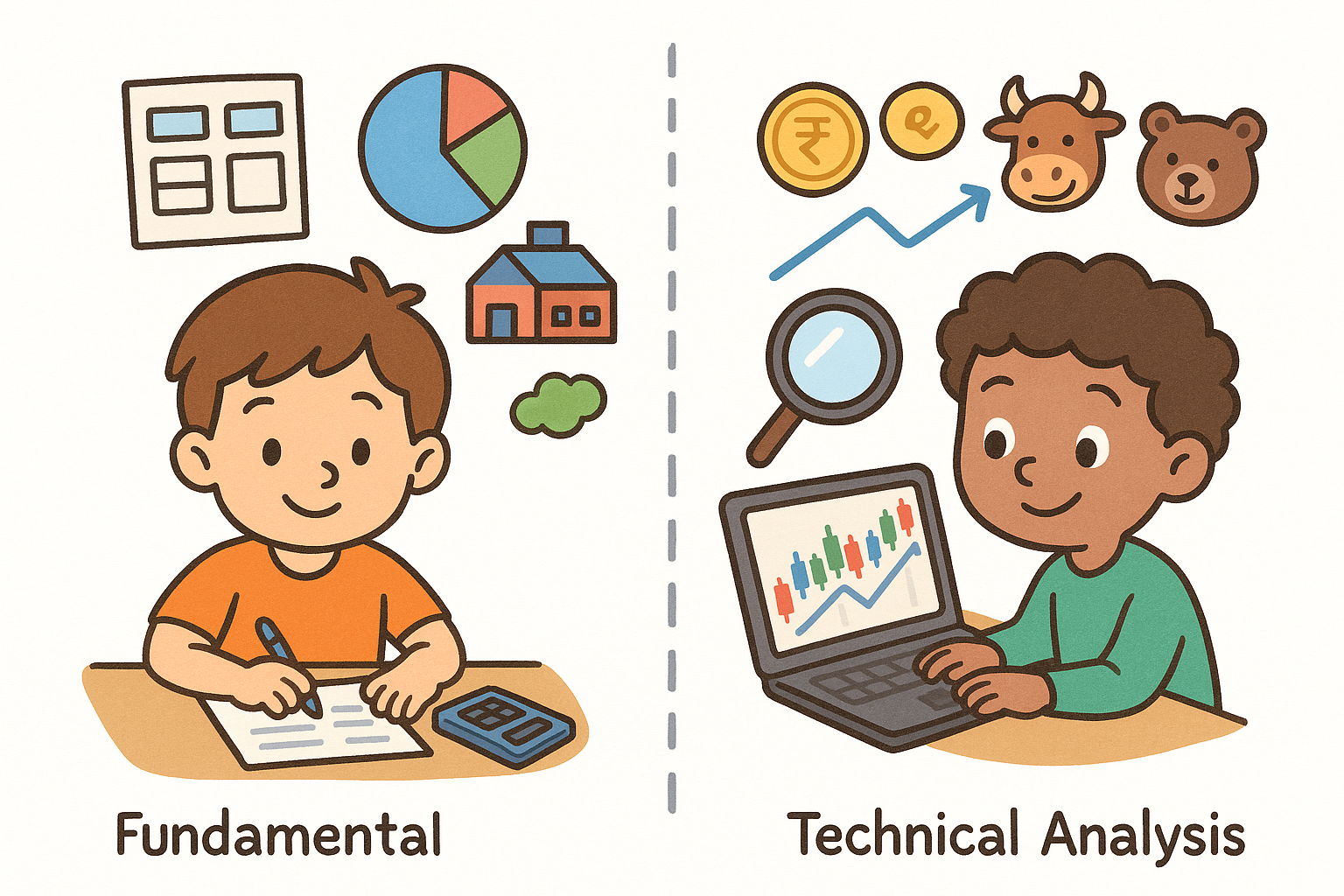
While fundamental analysis examines a company’s health and intrinsic value, technical analysis studies price charts and trading patterns. Fundamentals help long‑term investors assess whether a business is sound, whereas technical tools are used for shorter‑term trading groww.in. Many investors combine both approaches: they pick quality companies based on fundamentals and use technical analysis to decide when to buy or sell.
Pros and Cons of Fundamental Analysis

Fundamental analysis can help investors identify undervalued businesses and encourages a comprehensive, logical approach. However, it takes time and effort, not everything can be measured perfectly and the benefits often appear only in the long term.
Tips for Young and New Investors
If you’re just starting, begin small, use trusted sources like SEBI filings, diversify your investments and be patient. Always ask questions and continue learning.
Conclusion

Fundamental analysis is like doing a health check on a business. Instead of getting distracted by daily market noise, it helps investors focus on how well a company actually runs, the strengths of its industry and the state of the economy. In India, where the stock market offers thousands of choices, fundamental analysis helps families pick companies with strong financials, good management and long‑term potential. By learning to read financial statements, calculate key ratios and look beyond the headlines, even young readers can become informed investors.
Whether you’re saving for a new bicycle or dreaming of building wealth, remember: investing is a marathon, not a sprint. With patience and knowledge, you can ride the ups and downs of the stock market and reach your goals.
📌 Disclaimer
I am not a SEBI-registered investment advisor or analyst. The information shared in this article is meant purely for educational and awareness purposes and should not be considered as financial, investment, or trading advice.
Any stocks, sectors, or companies mentioned here (such as Bharti Airtel, TCS, ICICI Bank, etc.) are only examples used to explain concepts and not buy, sell, or hold recommendations.
Stock markets are subject to market risks, and investment decisions should be made only after proper research, due diligence, or consultation with a SEBI-registered financial advisor.
Past performance does not guarantee future returns. Please invest carefully and responsibly.
If You Liked This Article, Then You Might Also Like This –
Active vs Passive Investing: A Kid‑Friendly Guide for Indian Families