
Table of Contents
Understanding how people feel about the stock market is like noticing whether the playground is filled with smiles or frowns. In finance, this collective mood is called market sentiment. If investors are feeling optimistic and confident, they tend to buy more shares, pushing prices up. If they are worried, they sell, causing prices to drop.
This article is written so that children as young as 10 can follow along. It includes colorful cartoon illustrations and examples from both India and the United States to show how market mood can sway the fortunes of companies and entire economies. We will also learn how to measure this mood and why it matters for families and investors.
What is Market Sentiment?
Market sentiment is the overall mood of investors. The financial education site Investopedia explains that market sentiment reflects investors’ attitudes toward stocks, industries or the entire financial market. This mood is influenced by crowd psychology, which shows up in buying and selling actions. investopedia.com
When prices are rising and people are happy, the sentiment is bullish; when prices fall and people are pessimistic, the sentiment is bearish. The concept is important for day traders, technical analysts and contrarian investors who use the mood of the crowd to inform their decisions.
Imagine that the stock market is like a seesaw at the park. A happy bull jumps up on one side and lifts the seesaw high; this is like a bullish market where investors are buying and prices go up. A sad bear sits heavily on the other side and tips the seesaw down; this is like a bearish market where investors are selling and prices drop.
Market Mood and Crowd Psychology
The mood of the market can change quickly. A piece of good news, such as a company reporting strong earnings or a new government policy that encourages business, can lift people’s spirits. Likewise, bad news, such as a natural disaster or a company scandal, can make investors nervous. Because sentiment is emotional, it does not always match the underlying value of a company. Prices often move for reasons beyond what fundamental analysis would suggest. investopedia.com
Why Market Sentiment Matters
Sentiment Influences Prices and Decisions

Market mood directly influences buying and selling activity. When people are enthusiastic, they rush to buy shares, which pushes prices higher. When they are scared, they sell quickly, driving prices down. Investopedia notes that sentiment reflects investors’ current mood and can influence market behaviour.
It also points out that emotional responses rather than fundamental analysis often drive market sentiment. Understanding this mood helps investors avoid being swept up in a stampede of fear or greed.
Different types of investors use sentiment in different ways. Day traders and technical analysts look at market mood to profit from short‑term price moves caused by crowd psychology.
Contrarian investors do the opposite of the crowd—if everyone is buying, they may sell, hoping to buy back later at lower prices. Knowing whether the crowd is overly excited or overly worried can help investors decide when to jump in or step back.
To help visualise how sentiment affects trading decisions, imagine a classroom where a teacher draws a smiling bull and a frowning bear on the chalkboard. The students learn that when most people feel like the bull, stocks tend to go up, and when they feel like the bear, stocks tend to go down.
The Importance of Sentiment in Options and Derivatives
Market mood does not just affect share prices; it also influences the prices of options and other derivatives. Indian financial services firm Bajaj Finserv explains that tools such as the Volatility Index (VIX), put‑call ratios and sentiment surveys provide valuable insights into investor emotions.
Sentiment can significantly affect option prices because these contracts are bets on whether a stock will rise or fall. In bullish markets, call options (bets on rising prices) become more expensive; in bearish markets, put options (bets on falling prices) rise in price. bajajbroking.in
Types of Market Sentiment

Analysts often describe market mood as positive, neutral or negative. Bajaj Finserv classifies sentiment into these three categories:
- Positive sentiment means investors are confident and optimistic. Signs include increased buying activity, upward movement in stock prices and good economic news. It is like a sunny day where everyone wants to play outside.
- Neutral sentiment indicates indecision or a wait‑and‑see attitude. Prices may move sideways, trading volumes are moderate and investors are looking for clearer signals. This is like a cloudy day where kids aren’t sure if it will rain.
- Negative sentiment reflects pessimism and caution. Indicators include higher selling pressure, falling stock prices and emphasis on risk aversion. It is like a rainy day when everyone wants to stay indoors.
Another way to visualise the mood is with a simple gauge or speedometer. The indicator moves from red (bearish) to yellow (neutral) to green (bullish). Traders use similar tools in their analysis.
For example, the High‑Low Index compares how many stocks are at their 52‑week highs versus how many are at 52‑week lows; when the index is below 30, investors are bearish, and when it is above 70, they are bullish. investopedia.com
How Do People Measure Market Sentiment?

Because sentiment is a feeling rather than a number, investors use various indicators to measure it. Here are some common tools simplified for young readers:
- Volatility Index (VIX) – the “fear index.” The VIX measures how volatile investors expect a market (like the S&P 500 in the U.S. or the Nifty 50 in India) to be in the near future. A high VIX suggests investors are worried, while a low VIX implies calm. In India, the India VIX is based on variables such as stock price, strike price and implied volatility; a reading below 15 implies low volatility while above 35 signals high volatility.
- High‑Low Index. As mentioned above, this indicator compares the number of stocks hitting their 52‑week highs with those at 52‑week lows. An index below 30 indicates bearish sentiment; above 70 indicates bullish sentiment.
- Bullish Percent Index (BPI). The BPI counts how many stocks are showing bullish chart patterns. When the BPI is 70 % or higher, it signals optimism; when it is 30 % or lower, it indicates pessimism.
- Moving averages. Traders look at the 50‑day and 200‑day moving averages of a stock or index. If the 50‑day average crosses above the 200‑day average, creating a “golden cross,” it signals bullish momentum. If the 50‑day crosses below, known as a “death cross,” it signals bearish sentiment.
- Put‑Call Ratio. This ratio compares the number of put options (bets on falling prices) to call options (bets on rising prices). A high ratio suggests that many investors are buying puts, indicating bearish mood; a low ratio implies bullishness.
- Sentiment surveys. Organizations like the American Association of Individual Investors (AAII) conduct surveys asking investors if they feel bullish, bearish or neutral. Analysts use these surveys to gauge whether optimism or pessimism is dominant.
- Social media and news analysis. Monitoring posts and news headlines can reveal the tone of conversations. Bajaj Finserv notes that social media platforms have become significant channels where investors share opinions, and tracking this sentiment helps identify emerging trends.
Factors That Influence Market Mood

Market sentiment doesn’t appear out of thin air. It is shaped by many factors, including:
- Economic indicators. Interest rates, inflation, gross domestic product (GDP) growth and unemployment levels all affect how investors feel. For example, low interest rates can make it cheaper to borrow money, encouraging investment and creating a positive mood.
- Corporate earnings. When companies report strong profits, investors feel confident. Weak earnings can lead to pessimism.
- Political events. Elections, policy changes and geopolitical events can sway sentiment. In India, general elections often cause volatility; the market rallied after the 2019 re‑election of Prime Minister Narendra Modi.
- Market trends. Bull and bear markets can set the overall tone. Social media, news releases and public opinion can shift sentiment quickly.
- Market volatility. Nervous sentiment often prevails when prices swing wildly.
- Investor behaviour. Fear and greed among investors profoundly influence sentiments.
Real‑Life Examples from India
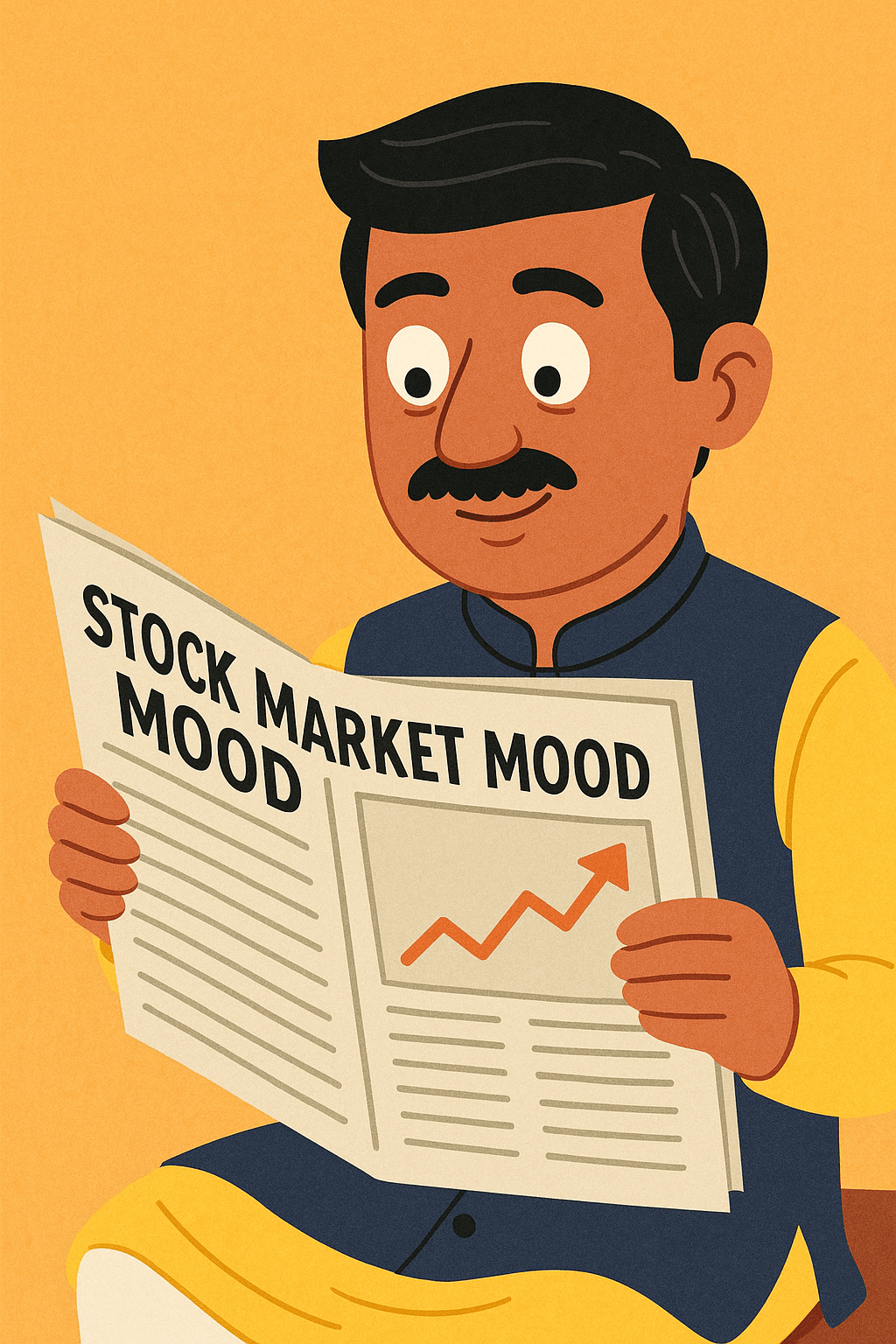
Market sentiment can swing dramatically in response to major events. In India, general elections are a good example. The investment research firm Equentis reports that result day often witnesses extreme market movements.
When a business‑friendly government wins, the Sensex (India’s main stock index) can surge; when the outcome is uncertain, the market may fall. equentis.com After the re‑election of Prime Minister Narendra Modi in May 2019, the Sensex jumped more than 1,400 points, showing how optimism about political stability can drive a rally.
Indian investors also watch the India VIX. Bajaj Finserv explains that this index uses variables such as stock price, strike price, expiry and implied volatility to estimate expected market volatility; a reading below 15 implies low volatility while above 35 signals high volatility. During uncertain times, India VIX spikes, reflecting fear; when calm prevails, it falls, showing confidence.
Another example involves global technology news. When Elon Musk bought the social media platform Twitter in October 2022, he laid off about 3,700 employees. Bajaj Finserv notes that the negative media coverage and concerns among investors led to a sharp decline in Tesla’s share price, falling by 54 %.
Although Tesla’s business model remained sound, investor confidence was shaken. This example shows that sentiment can drive stock prices even when fundamentals have not changed.
Real‑Life Examples from the United States
Sentiment During the COVID‑19 Pandemic and the Financial Crisis
Market mood in the United States has been tested during crises. Researchers at the Federal Reserve Bank of San Francisco developed a Daily News Sentiment Index to track the tone of U.S. economic news. Their analysis found that the sentiment index plunged in January 2020 when U.S. news began reporting about the possible impact of the coronavirus on the economy.
The drop accelerated in early March as coverage of the pandemic increased. By early April, the sentiment index flattened at a very low level. The researchers compared this to the 2008 financial crisis and noted that news sentiment dropped very rapidly during both crises, reaching a bottom in about 50 days.
Despite the severe economic downturn, the U.S. stock market rebounded quickly in 2020. However, the researchers observed that news sentiment remained near its trough even as stock prices recovered. This shows that investor mood and news tone do not always move in the same direction as stock prices; sometimes people remain cautious even when markets recover.
The GameStop Meme Stock Frenzy
Another dramatic example of crowd psychology occurred in January 2021 with the video‑game retailer GameStop. A group of retail investors on an online forum noticed that professional investors were betting against GameStop’s stock (short selling). They decided to buy the stock together to push the price up, forcing those who were short to buy shares to cover their positions—a short squeeze.
A legal analysis from Davis Graham & Stubbs LLP notes that GameStop’s stock price hovered below USD 20 during 2020. davisgraham.com It remained under USD 100 for most of January 2021 until January 26, when it closed at USD 146. Then, on January 28, the stock hit an eye‑popping high of USD 483 per share.
Retail investors celebrated as they “beat” the professionals. This event shows how social media and collective action can drive market sentiment far beyond a company’s fundamentals.
After the surge, some trading platforms restricted buying of GameStop shares, and the price quickly fell back to USD 347.51 by the end of the day. The regulators and the Securities and Exchange Commission examined the situation.
For our purposes, the key lesson is that market sentiment—especially when amplified by social media—can cause prices to swing wildly. It reminds investors to be cautious and not to chase trends blindly.
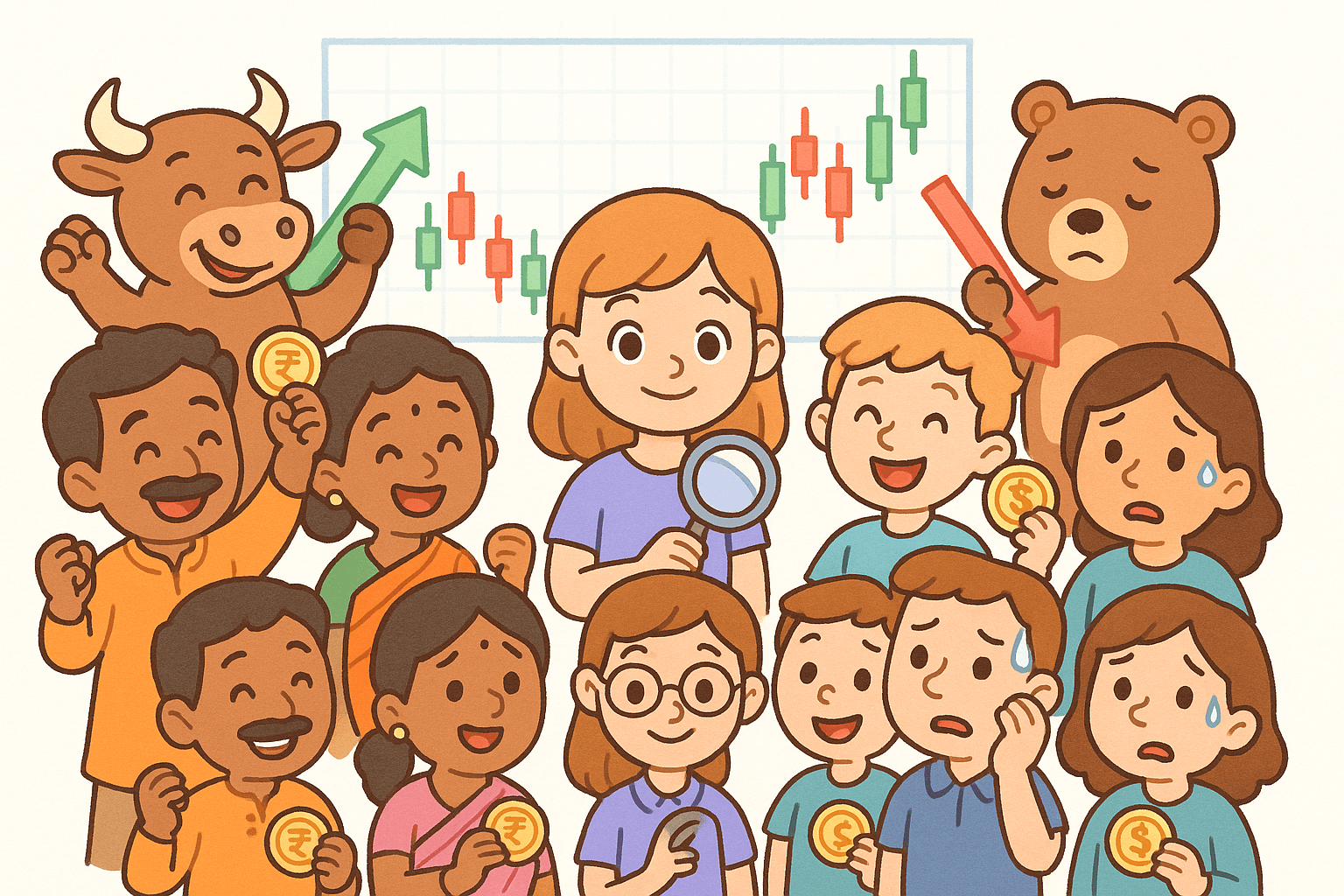
Crowd psychology also plays a role. When everyone rushes to buy a stock, others often join in, not wanting to miss out. The phenomenon is called herd behaviour. In the GameStop example, herd behaviour turned a struggling video‑game retailer into the centre of a trading frenzy. Another illustration shows a crowd of investors with mixed emotions—some cheering and others nervous—to represent how the crowd can drive prices up or down.
How Kids and Families Can Think About Market Sentiment

Market sentiment may sound complex, but it is just another way of saying how people feel about investing. Here are some simple tips for young readers and their families:
- See the market mood like the weather. Just as weather can change from sunny to rainy, investor mood can shift quickly. It is normal for markets to go up and down. Keeping calm during storms helps you make better decisions.
- Do your homework. Even when everyone seems excited about a stock, it is important to look at the company’s real performance. Remember that sentiment often does not match fundamentals. Reading financial reports, checking earnings and understanding what a company does can help you make more informed choices.
- Be cautious of herd behavior. Following the crowd without thinking can lead to losses. The GameStop episode shows that prices can be inflated by social media hype. Use sentiment indicators and fundamental analysis rather than rumors.
- Balance your investments. Long‑term investors focus more on a company’s fundamentals than on short‑term mood swings. Diversifying your investments across different companies and sectors can reduce the impact of sudden shifts in sentiment.
- Learn from different countries. Market mood affects both the Indian and American stock markets. Elections in India can cause rallies or sell‑offs, while U.S. news sentiment can diverge from stock market performance. Understanding examples from both countries broadens your perspective.
Conclusion

Market sentiment is the collective mood of investors. It reflects whether people feel optimistic or pessimistic about stocks and the economy. This mood can be bullish or bearish, and it often influences buying and selling even when the fundamentals have not changed. investopedia.com
Various indicators—such as the VIX, high‑low index, put‑call ratio and sentiment surveys—help measure the mood and allow traders to make more informed decisions. Many factors shape market sentiment, including economic indicators, corporate earnings, political events and investor behaviour.
Real‑world events from India and the United States show how powerful sentiment can be. The Sensex rally after the 2019 Indian election, the plunge in U.S. news sentiment during the COVID‑19 pandemic and the wild GameStop saga all demonstrate that mood swings can move markets. By understanding market sentiment, paying attention to fundamentals and avoiding herd behaviour, investors—young and old—can navigate the financial playground with more confidence and less fear.
If You Liked This Article, Then You Might Also Like This –
What are Market Cycles ? Explained for Beginners






One comment on “What Is Market Sentiment and Why It Matters”