
Table of Contents
Understanding how different countries grow and trade is a bit like looking at two types of gardens: some gardens are already full of big trees and colorful flowers, while others are still growing their first plants and need more care. In economics we use the words developed markets and emerging markets to describe these gardens. Developed markets are like well‑established gardens where things grow at a steady pace. Emerging markets are like gardens still growing quickly – they might have fewer flowers today but could have many tomorrow. This article explains the differences in a way that is easy for young learners, using examples from the United States and India. It also includes fun illustrations to make the ideas clear.
What is a market?
A market is any place where buyers and sellers come together. When we talk about a country’s market, we mean all the businesses, workers and customers that produce and trade goods and services. Countries can be grouped based on how their markets perform:

- Developed markets (also called advanced or mature markets) are countries with strong economies, high incomes and stable rules. The International Monetary Fund (IMF) says advanced economies have high per‑capita incomes, a diversified export base and financial systems integrated with the global economy. Examples include the United States, Canada, Japan, Germany and the United Kingdom.
- Emerging markets are countries transitioning from low or middle income to high income. These countries experience rapid economic growth but do not yet meet all the standards of developed markets. Corporate Finance Institute notes that emerging markets have some characteristics of a developed economy but not all. They tend to have lower income per person, rising industrialization and improving financial systems. Examples include India, China, Brazil, Indonesia and South Africa.
Key features of developed markets
Developed markets share several important characteristics. These help investors, companies and governments decide how to interact with them.
High income and living standards

A common way to measure development is income per person. Investopedia explains that developed economies have high per‑capita GDP (the total value of goods and services produced per person). Many economists consider a per‑capita GDP above US$25,000 to US$30,000 as a sign of developed status. The United States demonstrates this: the IMF projected that the U.S. nominal GDP per capita would be about US$89,599 in 2025. This means the average American produces goods and services worth nearly US$90,000 each year.
Developed markets also score high on non‑economic measures like life expectancy and education. Most developed economies have Human Development Index (HDI) values above 0.8, showing that people live long, healthy lives and receive good education.
Advanced infrastructure

In developed markets, roads, ports, power lines and internet connections are well‑built and maintained. Trains run on time, bridges are sturdy and most cities have reliable electricity and clean water. The left side of the image below shows a modern city with skyscrapers, wide roads and a high‑speed train, representing the infrastructure typical of a developed market. The right side contrasts this with construction sites and developing roads, similar to the situation in many emerging markets.
Stable financial systems
Developed markets have deep and liquid financial markets. A liquid market means people can buy and sell stocks or bonds quickly without causing big changes in price. TradingView notes that stock exchanges in developed markets (like the New York Stock Exchange or NASDAQ) offer high transparency and strong corporate governance. tradingview.com Investors trust these markets because companies follow strict accounting rules and governments enforce them.
Strong legal and regulatory environment

Clear rules and fair courts are essential. Developed markets usually have predictable policies, rule of law and strong regulatory systems. Investors know that contracts will be enforced and property rights are protected. This stability encourages both local and foreign investors to buy businesses, build factories and create jobs.
Demographic trends
Developed countries often have aging populations. People live longer and birth rates are lower. For example, many households in developed economies like Japan and parts of Europe have more grandparents than young children.
An older population can lead to slower economic growth because there are fewer young workers. However, older societies often have more savings, which can be invested back into the economy.
Key features of emerging markets
Emerging markets share traits that distinguish them from developed markets. These characteristics explain why they grow quickly but also present more risks.
Rapid economic growth
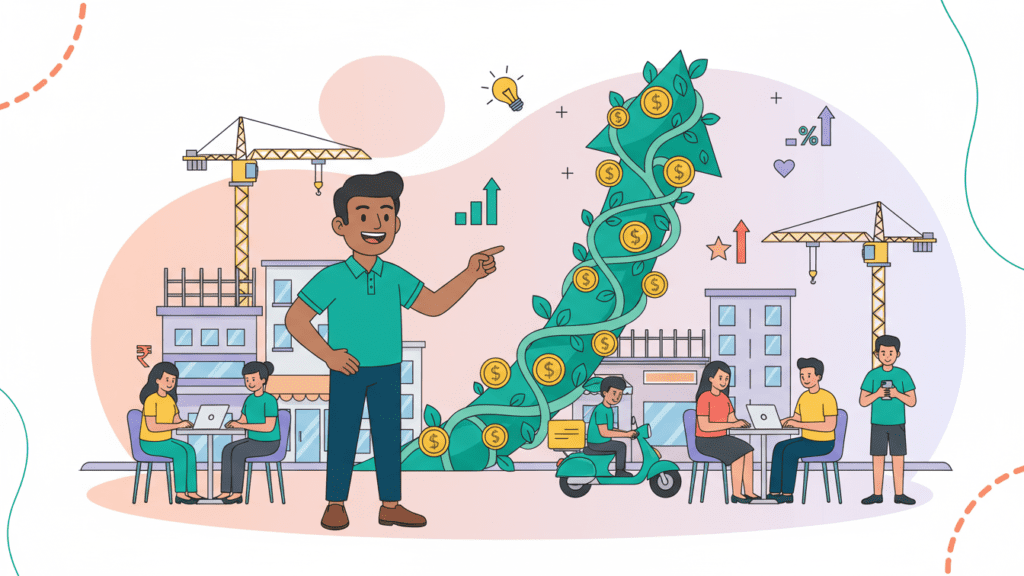
Governments in emerging markets often implement policies that favor industrialization and rapid economic expansion. Countries like India and China have grown at 7–10 percent per year during some periods. This growth is driven by factors such as:
- Urbanization and rising middle class: As more people move from farms to cities, they earn higher wages and spend more.
- Investment in manufacturing and services: Emerging markets build factories and call centers that sell products and services to the world.
- Technological leapfrogging: Many skip older technologies and adopt new ones directly, such as India’s booming digital payments system.
Lower income levels but rising

Compared with developed markets, income per person in emerging markets is lower. In India, for example, per‑capita income in fiscal year 2024–25 is estimated around US$2,600. This has risen from about US$1,183 in FY 2016‑17, showing steady improvement. Market analysts predict it could approach US$5,000 by 2030. Although low compared to the U.S., this increase means more Indians can afford better food, housing and education over time.
Developing infrastructure

Infrastructure in emerging markets ranges from modern airports and metro systems to rural areas without paved roads. The right side of the infrastructure illustration shows construction sites, dirt roads and an auto‑rickshaw—symbols of developing transport and housing. Governments often invest heavily in infrastructure to support growth.
Less mature financial markets
Emerging markets have growing stock exchanges and banks but they are smaller and less liquid than those in developed countries. TradingView explains that emerging markets have lower liquidity, higher volatility and varying investor protections. This means share prices can change quickly, and investors might find it harder to sell shares without affecting the price.
Greater market volatility

Prices of stocks, bonds and currencies in emerging markets can rise or fall rapidly due to changes in politics, weather, commodity prices or global economic conditions. The Palance blog notes that emerging markets often experience greater fluctuations because data is limited and regulatory frameworks are less stringent. blog.palance.co
Young, growing populations
Unlike developed countries, emerging markets generally have younger populations. More young people enter the workforce each year, providing labor for factories and offices. A youthful population can boost economic growth through innovation and spending, as seen in India’s technology sector.
Comparing developed and emerging markets
The table below highlights the major differences between the two groups. Tables use short phrases to help you see patterns quickly.
| Feature | Developed markets (e.g., USA) | Emerging markets (e.g., India) |
|---|---|---|
| GDP per capita | High (often above US$25,000 and the U.S. projected US$89,599 in 2025) | Lower but rising (India about US$2,600 in FY 2024‑25) |
| Economic growth rate | Slower but steady (1–3 % per year) | Faster (4–7 % or higher) |
| Infrastructure | Modern roads, railways and utilities | Mix of modern and developing; many projects underway |
| Financial markets | Deep, liquid, highly regulated | Smaller, less liquid, more volatile |
| Currency stability | Stable currencies, low inflation | More prone to currency swings and inflation |
| Regulatory environment | Predictable policies and strong rule of law | Policies can change quickly; regulation may be less consistent |
| Demographics | Aging populations with high life expectancy | Young, growing populations |
| Investment characteristics | Offers stability and lower risk | Offers higher growth potential but higher risk |
Example: United States vs. India
Income and living standards

The United States is one of the world’s richest nations. In 2025, the IMF projects U.S. GDP per capita at about US$89,599. Americans typically have modern homes, reliable healthcare and quality schools. These numbers show that the average American produces and consumes many goods and services.
India’s per‑capita income is much lower, around US$2,600 in FY 2024‑25. However, this number has more than doubled since 2016 and is expected to keep rising. As incomes grow, Indian households shift from spending only on necessities to buying more branded and lifestyle products. Rising income also supports more spending on education, healthcare and technology.
Infrastructure
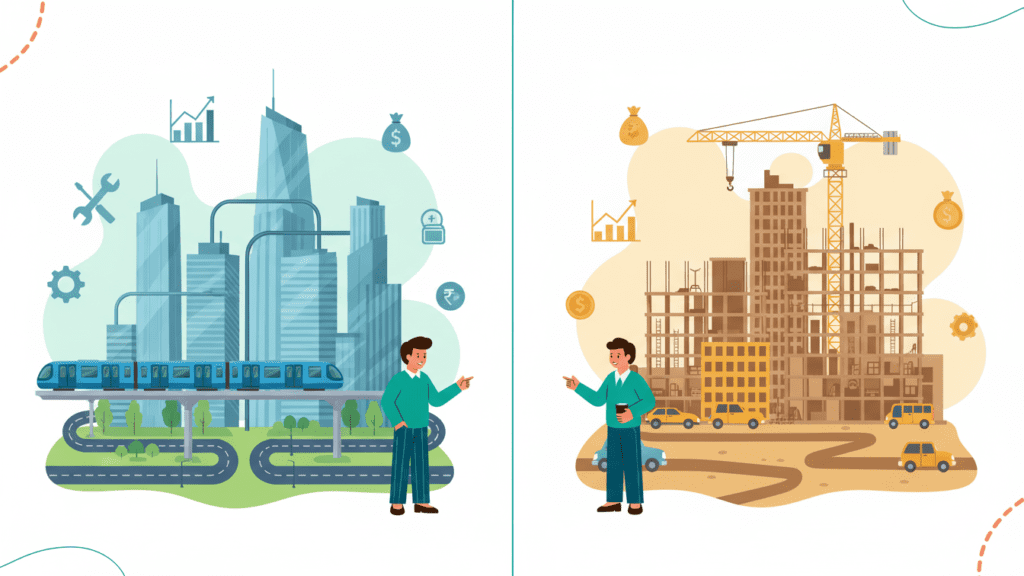
The U.S. has long‑established highways, airports and railroads. American cities rely on mass transit systems and many households own cars. The high‑speed train in the earlier illustration represents how developed markets often have efficient public transport.
India is simultaneously building world‑class airports and metros while also improving roads in rural areas. Many cities now have modern metro systems, but some villages still depend on dirt roads. Development is uneven: megacities like Delhi and Mumbai enjoy advanced transportation, while rural areas work to catch up. Over the next decade, large infrastructure projects aim to close this gap.
Financial markets

U.S. financial markets are among the deepest in the world. The New York Stock Exchange and NASDAQ host thousands of companies. Investors can buy and sell shares quickly, and rules protect investors’ rights.
India’s stock market is one of the world’s largest by number of listed companies, but trading volumes are lower and prices can swing more. Regulation has improved in recent years, but some companies still have limited disclosure. India’s rapid adoption of digital payments—where even small roadside shops accept QR code payments—shows how emerging markets can leapfrog technology.
Demographics

The median age in the U.S. is around 38 years, and many other developed countries have even older populations. More retirees mean higher healthcare costs and slower economic growth.
India’s median age is about 28 years, with a large share of young people entering the workforce. This “demographic dividend” can fuel economic growth if young workers find productive jobs. More youths also encourage adoption of new technologies and spark innovation.
Political and regulatory environment
U.S. institutions are well established. Laws change slowly, and courts are independent. Businesses can plan far into the future knowing that tax rules, property rights and contract enforcement are relatively stable.
In India, rules evolve rapidly to match global standards. Reforms have simplified business registration, improved bankruptcy resolution and strengthened consumer protections. However, bureaucracy and policy changes can still pose challenges. Investors often watch elections and policy announcements closely because these events can affect interest rates, exchange rates and stock prices.
Why investors care about the differences

Investors look at both developed and emerging markets when deciding where to put their money. Each type offers advantages and risks:
- Stability vs. growth: Developed markets provide steady growth and lower risk. Emerging markets offer faster growth but can be more volatile. TradingView notes that emerging markets often deliver annual GDP growth of 4–7 percent while developed markets grow 1–3 percent.
- Income level and consumption: High incomes in developed markets mean consumers can buy more expensive products. In emerging markets, incomes are rising quickly, creating new opportunities for companies to sell products like smartphones, electric vehicles and luxury goods. Franklin Templeton’s study (quoted in India Briefing) suggests India’s per‑capita income could approach US$5,000 by 2030, leading to more discretionary spending.
- Diversification: Adding emerging‑market investments can increase potential returns because they do not always move in the same direction as developed markets. However, investors must be prepared for larger swings in price.
- Risk management: The Palance blog explains that emerging markets can be more affected by political events and currency fluctuations. This is like riding a roller coaster, as shown in the volatility illustration. Developed markets offer a smoother ride but may yield smaller gains. Investors often mix both to balance risk and reward.
Working together

Developed and emerging markets are connected through trade, investment and ideas. Developed countries often invest money and technology in emerging markets, while emerging markets supply goods, services and labor. For example, American companies invest in India’s software and engineering sectors, while Indian companies export pharmaceuticals and services to the U.S.
Economic relationships can benefit both sides. Developed markets gain access to new customers and cheaper production. Emerging markets receive capital, jobs and knowledge.
Conclusion
Developed and emerging markets are different stages in the economic journey of countries. Developed markets like the United States are like mature gardens: they have high incomes, modern infrastructure and stable rules, but they grow slowly. Emerging markets like India are like young gardens: incomes are lower and there is a lot of work to do, but the plants are growing quickly and have huge potential.
For investors, families and students, understanding these differences helps make sense of world news and financial decisions. Developed markets provide safety and predictability, while emerging markets offer excitement and rapid change. By appreciating both, we can enjoy the flowers in full bloom and look forward to the seeds that are just beginning to sprout.
If You Liked This Article, Then You Might Also Like This –
What Is Short Selling? A Simple Step-by-Step Explanation for Beginners